

A Meeting Gone Wrong?
In a tense Moscow summit between Vladimir Putin and his Armenian counterpart Nikol Pashinyan, Yerevan's intentions to scale back Russian economic cooperation were made more visible than ever before

On April 1, 2026, Armenian Prime Minister Nikol Pashinyan and a delegation of Armenian officials travelled to Moscow, Russia, to meet with a host of leaders in Russian government and industry, including Russian President Vladimir Putin, Foreign Minister Sergei Lavrov, Rosatom’s Alexei Likhachev, and Russian Railway’s Andrei Belozerov. The latter two figures command Russia’s premier state-affiliated energy and transit corporations respectively, both of which have been deeply integrated within the Armenian economy since the country’s secession from the U.S.S.R. in 1991.
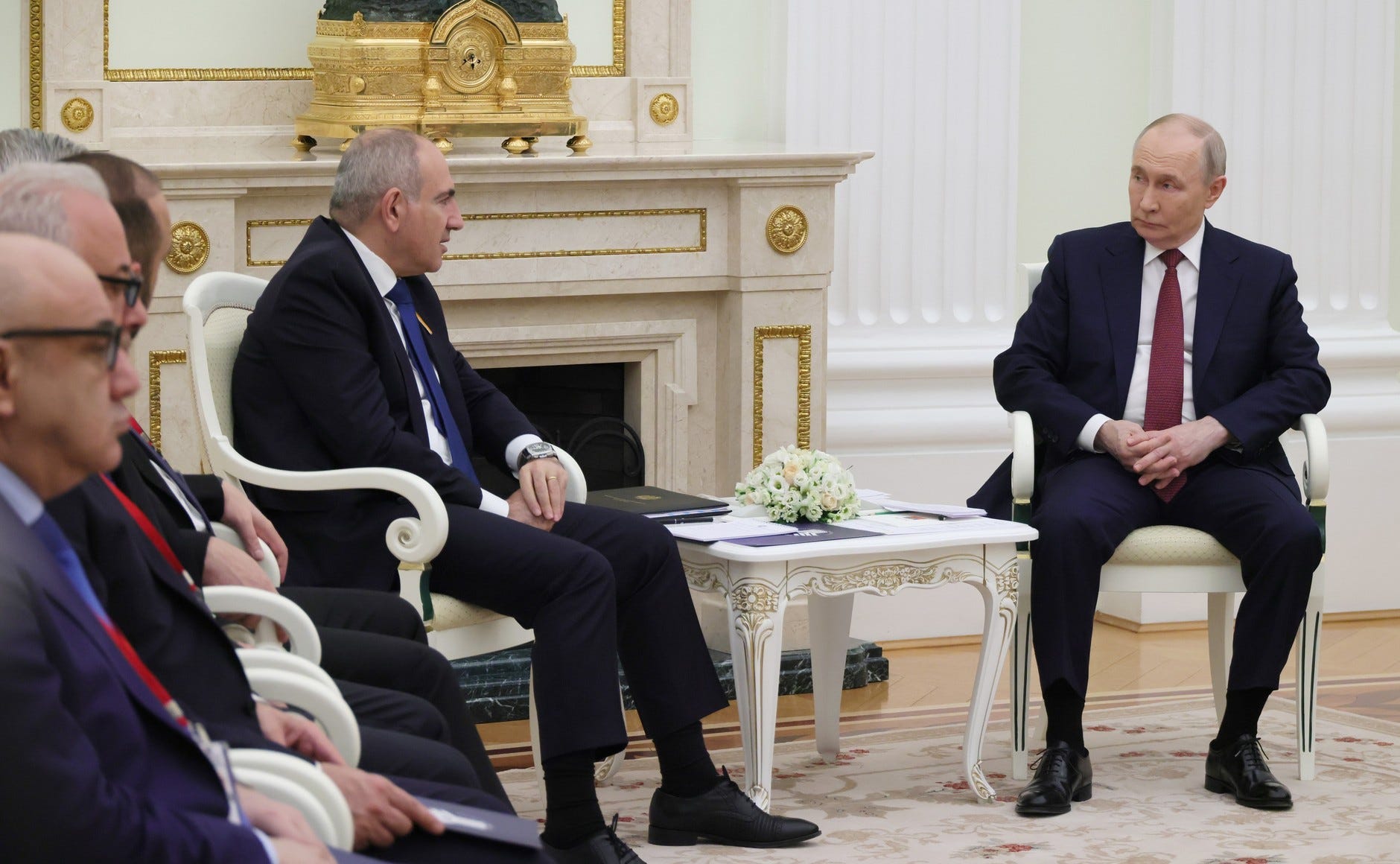
The tense meeting between the two leaders comes amidst a growing backdrop of precarious Russian-Armenian ties and of growing cooperation between Yerevan and the European Union.
As a member of Russia’s C.S.T.O. military alliance and its Eurasian Economic Union (E.A.E.U.), Armenia’s relationship with the Russian Federation once formed the crux of its foreign policy. To Yerevan, Moscow provided the political, economic, and military umbrella which the small and landlocked country required to deter its two adversarial neighbors: Turkey and Azerbaijan.
Russia’s failure to provide a military backstop for the Armenians during Azerbaijan’s ground offensive into the disputed region of Nagorno-Karabakh in 2023 provided the impetus for Yerevan’s departure from the Russian relationship, which had now proven itself to be unreliable and impractical amidst Moscow’s military overextension in Ukraine.
Between now and then, Armenia has taken extensive efforts to diversify its array of political and economic relationships with neighboring countries in Europe, the Middle East and the South Caucasus. Under President Nikol Pashinyan, accession to the EU, reconciliation with the western-aligned countries of Turkey and Azerbaijan, and weaning off of Russian economic dominance within the small post-Soviet country have all become serious priorities. As Russia’s status as a regional Eurasian hegemon continues to waver, it’s no wonder that Putin’s concerns over Armenia’s departure from Moscow’s sphere of influence became a point of contention during his meeting with the Armenian P.M.
Points of Concern:
Putin’s meeting with Pashinyan was complemented by notable appearances from major figures in the Russian private railway and energy sectors. This was not engineered out of coincidence, but rather to insinuate the fundamental rift forming between Armenia’s desires for economic autonomy and Russia’s efforts to keep Yerevan from detaching itself from the Russian sphere of influence.
Armenia is the smallest and most isolated of all the post-Soviet successor states. Until recently, its lacking industrial base, problematic geography, and proximity to numerous hostile countries have made Russian patronage a deeply vested attribute of the country’s economic sector. To this day, Armenia’s railway networks are operated by the Russian-owned Russian Railways, while its hydrocarbon and nuclear energy needs are largely facilitated by Russian pipelines, Russian power plants, and Russian oil fields. The inherent dependency is stark, and Armenia’s efforts to upend it after its falling-out with Russia in 2023 have been met with predictable friction.
In the past year alone, Armenia has attempted to diversify control of its transit and energy needs away from Russia through the American-administered T.R.I.P.P. Corridor to increase commercial activity throughout the South Caucasus and also through potential American involvement in the construction of Armenia’s new premier nuclear power plant. Both initiatives have involved state visits by high-ranking officials like U.S. Vice President J.D. Vance, and while neither economic initiative explicitly denies Russian commercial dominance within Armenia, they most certainly challenge it by introducing the United States as an economic competitor within the country.
Another key issue in the Armenian-Russian relationship revolves around Yerevan’s growing momentum behind gaining membership status within the European Union— a natural “next step” in its efforts to economically detach from the Russian sphere. While Armenia’s fallout with Moscow in 2023 precipitated a de-facto end of Yerevan’s involvement within the C.S.T.O., the country still remains within the Eurasian Economic Union’s free trade area with Russia. While Armenia’s economic dependency with Moscow is still an insurmountable reality, Pashinyan knows good and well that his country’s pivot westwards would be mutually exclusive with continued membership in the E.A.E.U.
Economic Coercion:
Russia has not stood idle in the wake of Armenia’s newfound geopolitical agency. Putin’s summit with his Armenian counterparts was categorized by prototypical coercion—albeit implicitly— coupled with tangible economic posturing at Yerevan’s expense.
In an effort to confront Armenia’s efforts at industrial diversification with secondary parties like the US and Europe, the Russian delegation declared that there was “no objective reason” for Armenia to explore ending Russia’s strategic monopoly over Armenia’s railway system. Pashinyan also raised concerns that Russia was violating long-term agreements surrounding the increased price of oil imports from Russia, to whom Armenia relies almost entirely upon for that particular commodity.
Russia’s ability to leverage its vast oil supplies against the resource dependency of many of its smaller neighbors has always been a mainstay of the Kremlin’s foreign policy agenda: it was used to keep Germany from responding decisively to the annexation of Crimea, to paralyze Moldova’s westward leanings at Russia’s expense, and to gain a considerable say in the variance of oil prices globally. For small and resource-scarce countries like Armenia, the strategy is particularly effective.
Vladimir Putin also took a disdainful interest in Armenia’s growing efforts towards E.U. accession. While Putin claimed to be “absolutely calm” about such prospects, he also asserted that such a development would render Armenia’s continued involvement in the E.A.E.U. null and void.
Vladimir Putin would most certainly oppose Armenian accession to the EU, just as he has when every other post-Soviet country has tried to (and usually failed). Therefore, it’s quite likely that his projected attitude of indifference to the proposition is fabricated. While it is impossible to assess the ulterior motives behind the Russian President’s vacuous words, it’s possible that his phrasings are meant to conceal Russia’s inability to prevent Armenia’s E.U. accession amidst his country’s overextension in Ukraine under an auspices of indifference that— at least to a certain extent— perpetuates a false notion that Russia is in control of the situation by simply not caring what happens.
On the contrary, Putin might think that the prospects of Armenian accession into the EU are so unlikely that commenting on the matter deserves no serious attention. This, too, has its merits—no post-Soviet states other than those in the Baltics have had success in joining the economic bloc, much less those which lie several hundred miles from the nearest EU member state and along the periphery of the Middle East.
Both theories do, however, converge around a singular and unwavering reality: in spite of Russia’s unprecedented collapse of influence throughout Armenia and the South Caucasus, Moscow can still utilize its deeply-entrenched influence within Armenia’s economic base to advance its foreign policy interests. In this respect, the inertia of Russian dominance which Yerevan needs to overcome to gain strategic autonomy might prove itself to be a far more resolute than expected.
Armenia’s Upcoming Electoral Cycle:
What greatly complicates Pashinyan’s foreign policy situation is an equally problematic domestic outlook. Armenia is scheduled to hold its parliamentary elections on June 7, later this year. While Pashinyan’s generally pro-Western “Civil Contract” party maintains a plurality in current polling numbers, he still faces a notable opposition led by the “Strong Armenia” party with explicit Russian-leanings. In fact, Strong Armenia is led by the billionaire Samvel Karapetyan, a man who holds passports from Armenia and Russia. Earlier this year, he was arrested on charges of pro-Russian collusion in the democratic process.
Pashinyan’s preferential leanings to the EU and the United States are more structural than they are partisan. Armenia’s strategic outlook was deeply compromised when Russia failed to halt Azerbaijan's strikes against Nagorno-Karabakh in 2023, a crisis which precipitated the need for new allies and foreign patrons: Europe and the United States. Armenia’s desire to detach from its unreliable former partner even led it so far as to reconcile with the Azeris and Turks, who have since adopted more conciliatory stances towards Yerevan.
As pragmatic as Pashinyan’s geopolitical maneuvering might be, the uncertainty that awaits him in upcoming parliamentary elections limits his ability to act in a manner that would leave his pro-Western base of support betrayed through inaction or the 37% of undecided Armenian voters with possible Russian sympathies feeling alienated or outraged by an economic fallout that would send Russian-imported gas prices skyrocketing. To that point, keeping consumer good prices low is perhaps the most universal key to success in the democratic system, and on this point Pashinyan knows that a soured relationship with the Kremlin would greatly compromise his chances at electoral victory.
In a sense, Armenia’s apparent domestic divisions limit its ability to pivot decisively from Russia in the immediate term. After all, the primary impetus for Pashinyan’s Moscow visit in the first place probably stemmed from a desire to smooth over ties with Putin lest the Kremlin retaliate against Armenia’s recent economic dealings with the United States.
Beyond his electoral outlooks, Pashinyan also has to face the mounting prospects of Russian economic warfare against his efforts at pivoting Westward, which could take the form of tariffs or price hikes on critical resources like oil. As formidable as Russia’s inherent leverage within Armenia’s political economy might be, however, we must not discount the efficacy which a serious electoral victory from Pashinyan’s party would bring to Armenia’s political resolve. Any such victory would give Pashinyan the breathing room and the popular mandate to be more decisive in his pivot away from Russia as ties between Turkey, Azerbaijan, the EU, and the United States all continue to grow.
Russia’s economic grip on Armenia is strong, but it is nowhere near as strong as it was just two years ago, nor is it as jarring as it is in similar-positioned countries like Moldova, Belarus, and perhaps even Georgia. As Yerevan continues to diversify its ties with regional and international players, its dependency on the Kremlin will continue to wane, and while the worst might be yet to come, so too is the best.
What matters most is that Armenia has “crossed the threshold” and gone through the narrow window of escape from the Russian sphere when it had the chance—in 2023, when Russia was too busy trying to conquer the Donbas. As Russia comes to recognize what it has since lost amidst its overextension, it will take greater interest in harassing Yerevan’s inner-workings, yet there is little it will be able to do to counter the competition which new players like Turkey and the United States are bringing to the table within a depolarized Armenian nation.
The sun is setting on Russia’s post-Soviet empire. In many ways, Moscow has only just begin to realize this, yet its subsequent and flamboyant efforts to reverse the inevitable will be more disruptive than they are destructive. This will only leave Armenia more alienated from its former ally, with whom a door has now irreversibly shut.
Fascinating detailed article! Your writing is consistently well researched and clearly written. We look forward to your next article!