

A Powder Keg Once More
A renewed political crisis in Serbia could have political implications that extend far beyond its own borders

To many a nation, the United States has long been seen as a “benevolent hegemon,” bringing relative freedom and prosperity to more nations than perhaps any other has in human history. Yet, this lofty perception is not shared by all, and perhaps the Serbs offer one of the best glimpses into the eclectic band of nations which hold quite an opposite view of the Pax Americana.

Serbia’s hard-fought victory over Bulgaria and Austria-Hungary in the Great War allowed it to annex virtually all of the Western Balkans, becoming a large, multi-ethnic state that would hold great influence in the region until its dissolution in the 1990’s. This “Greater Serbia,” which we simply know as Yugoslavia, was the only nation to rid itself of German occupation by its own accord in the Second World War, and throughout the Cold War it remained defiant of both Soviet and American influence under the leadership of Marshall Józef Tito.
It is understandable to see how Serbia’s legacy in recent history lends itself to a maxim such as “mind your own business,” which is exactly what the Serbs wish external forces to do in respect to their sovereignty and decision-making.
With the collapse of Yugoslavia in the 1990’s and the ensuing outbreak of the Yugoslav Wars between the Croats, Serbs, and Bosnians, Serbia’s wishes for international apathy were all but granted. As radicalized Serbian paramilitaries ravaged Bosnian, Croat, and Albanian communities in ethnically contested zones, NATO and the United States initiated a harsh response to what they saw as an unprecedented humanitarian crisis. Over the ensuing years, NATO air raids on Belgrade would force Serbia to withdraw its claims on ethnically-divided Bosnia and Albanian-inhabited Kosovo, creating an uneasy framework under the Dayton Accords which leaves a great unsatiated appetite for territorial revanchism among Serbia’s more radical factions.
Any moralist or humanitarian would agree that the West’s direct military intervention against Serbia in the 1990’s saved countless innocent lives from further violence. And, regardless of one’s realist political outlook on that particular conflict, it was probably the right course of action by NATO and the West. Nonetheless, the moral justification for these attacks has never been understood by the Serbs, who themselves bore the consequences of air raids on cities like Belgrade and Novi Sad.
The Serbs, an ardently nationalist and fiercely independent people, have naturally directed their grievances over Serbia’s defeat in the most recent Balkan War against the collective West, much in a similar way as have large sections of the Russian and Belarussian populations in response to Western support for Ukraine. These sentiments only persist in the present day,
Internal Strife:
Nearly three decades after the cessation of war in the Balkans, Serbia remains notably absent from NATO and the European Union, even though relations between the two have experienced somewhat of a recovery. Belgrade still retains a semi-authoritarian governmental framework, as well as amicable ties with the Russian Federation. All of these conditions place the nation as a great outlier among many of its other neighbors, who have firmly aligned with the West and are reaping the benefits of economic integration with Europe that Serbia has yet to experience.
The Serbian economy thus stands far behind many of its regional contemporaries, leading to a number of infrastructure shortcomings that culminated in a tragic train platform collapse in the city of Novi Sad in 2024 that killed dozens. Over the past nine months, droves of Serbians—mostly in the younger generations—have responded to this suspected result of government inefficiency and corruption by taking their grievances to the streets. And thus, the nation has been engulfed in perhaps its biggest wave of mass-unrest in decades. Riots have become commonplace, and on numerous occasions, the capital city of Belgrade has become engulfed in protests with numbers in the hundreds of thousands.
Aleksandar Vucic, the longstanding authoritarian leader of Serbia with close ties to the Kremlin, has responded to such unrest with violent repression. In what he understandably sees as a striking parallel to the Ukrainian “Maidan” uprisings of 2014, Vucic has asserted that Serbia’s present state of upheaval is merely the result of foreign intervention on behalf of the West. Whether this claim is true or not misses the point—Vucic’s government is in a sea of trouble, regardless of its source.
External Strife:
The situation developing beyond Serbia’s borders is of different origin but of equal importance. Ever since the Dayton Accords ended the war in Bosnia in 1995, the nation has been precariously split between two autonomous governments which nominally report to one, “centralized” governing body: Bosnia and Herzegovina. Of the two political entities, the Bosnian Serb-inhabited Republika Srpska provides the greatest impetus for a resumed tensions.
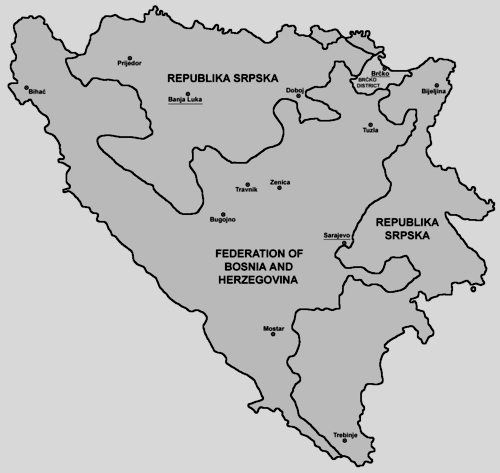
This de-facto political entity is widely held as a pariah among the international community. Under its leader, Milorad Dodik, Srpska has begun a process of disassociating itself from the Bosnian government in Sarajevo in defiance of the Dayton Accords. In response to such actions, which many fear could lead to outright secession, the Bosnian government has issued arrest warrants on Dodik, all of which have promptly been ignored. With elections in the Republika Srpska coming up this year, there can be no doubt that the political crisis facing Bosnia is unlike anything seen since its formation thirty years ago.
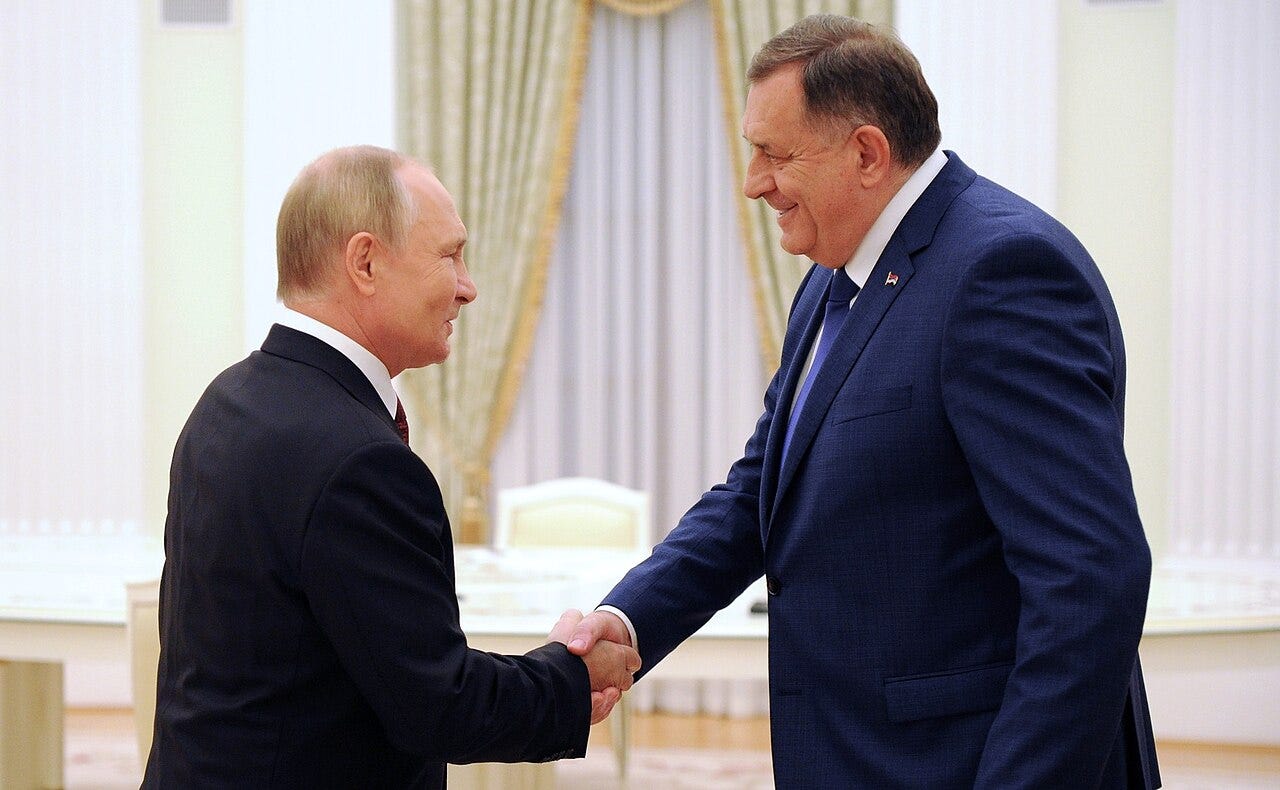
What makes matters worse is Dodik’s strong ties with Moscow, where he can often be seen among the personal entourage of Vladimir Putin himself. Many Bosnian and Western observers fear that, in Putin’s efforts to destabilize NATO amidst his full-scale invasion of Ukraine, Russia could easily use Dodik as a pawn to instigate a crisis that would invariably ripple throughout much of the Western Balkans and help divert European attention away from the ongoing conflict in Ukraine.
How it’s all Related…
Few in the West have been able to synthesize the seemingly unrelated crises in Serbia and Bosnia with one another. It is most certainly true that the root causes of both crises differ substantially, but any overlap which may present itself between the two developments has the potential to steer Balkan stability into a devolving spiral of chaos. Here are a few important points to consider:
While many Serbs hold grievances against Vucic’s government, their aredent nationalism exceeds even the greatest of domestic issues. If Vucic finds himself in a position where he needs to divert the anger of his people away from himself and towards, lets say, a “historical enemy” like Bosnia, he could easily manipulate the fragile situation in the Republika Srpska to save his skin and in doing so prompt armed conflict.
On the contrary, internal chaos in Belgrade may inspire Dodik to act more independently of a Serbian government which has traditionally preferred uneasy compromise with the West at the expense of its irredentist aspirations. The seeds for a “rogue state” independent of both Belgrade and Sarajevo would thus be born.
All of these developments reveal that NATO’s greatest area of weakness is in the Balkans. The framework which NATO created at Dayton in order to preserve Bosnian independence is coming under intense pressure at a time when Ukraine is fighting for its life. What makes matters worse is the growing pro-Russian sentiment in nearby Balkan countries, among them Slovakia, Romania, and Viktor Orban’s Hungary. While many may claim that the root cause of this trend is a concerted Russian effort at subversion among NATO’s member states, it is more likely a reflection of the timeless theme of hyper-nationalism and political turmoil which has categorized the Balkans for centuries.
The attention of Europe is undoubtedly centered on Ukraine at the moment, and for good reason. Yet, continued support to Ukraine requires continued cohesion within NATO itself. Regardless of how the situation in the Western Balkans develops, NATO must watch its “soft underbelly” so as to prevent a strategic breakdown at a time of the utmost importance in checking Russian expansion and preserving the status quo in Continental Europe.