

Caught in the Crossfire
The Caspian Sea sits at the uneasy convergence of Russia, Iran, the Caucasus, and Central Asia. As the conflict in Iran continues to escalate, chaos may very well wash ashore beyond Tehran.

Straddling the peripheries of Europe and Asia, the Caspian Sea is the largest inland waterway in the world. With the sea being shared by Russia, Iran, and a handful of post-Soviet states in the South Caucasus and Central Asia, the Caspian has long been conveniently detached from the military or economic power of maritime powers like Great Britain and the United States.
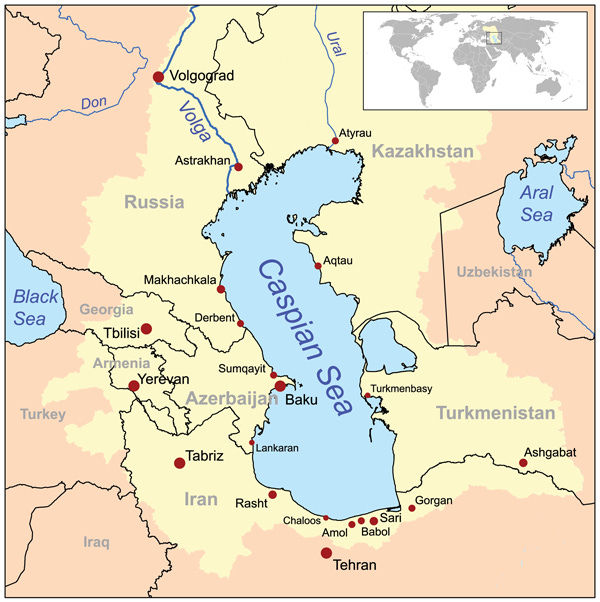
In an age where Russia and Iran’s revisionist aims have come under mounting scrutiny from the collective West, the Caspian Sea has become a preferable route for commerce and cooperation simply because none of their shared adversaries can reach it. Via Russia’s Volga River port of Astrakhan and Iran’s of Bandar e-Anzali, Tehran has been able to funnel drones into Russia’s war machine against Ukraine. The Russians, too, have employed the waterway to provide material support to Iran in the wake of Operation Epic Fury.
This prevailing historical reality, however, is showing signs of stress in an era wherein the West’s influence is expanding deep into the post-Soviet Caspian Basin in previously unforeseen ways. Furthermore, as Israel and the United States continue to expand the parameters of conflict in their aerial campaign against Iran, areas like the Caspian Sea that were once a safe haven for backdoor cooperation between Moscow and Tehran have become prime targets by a Western alliance that is rapidly closing in on Eurasia’s heartland…
The Lateral Axis: Central Asia and the West:
While the ongoing crisis in Iran is all-important to understanding the shifting balance of power in and around the Caspian Sea, the region’s broader trend of realignment can be best ascribed to structural changes occurring within the region’s once-dominant power: Russia.
During the times of the Soviet Union, the Caspian was categorically dominated by Moscow and, as such, was geopolitically irrelevant. It provided no foothold for rival powers farther west because of its geographic isolation, and the critical hydrocarbon and rare-mineral resources which surrounded it had no mitigating means of transit since they all lay within the contiguous territories of the U.S.S.R.
Following the Soviet collapse in 1991, three new nations—Kazakhstan, Turkmenistan, and Azerbaijan—inherited the bulk of the Caspian’s shoreline. Russia’s footprint on the waterway was relegated to the Volga basin in the north, while Azerbaijan inherited what had once been the sea’s most critical port city: Baku.
While the map of the Caspian basin was categorically redrawn by the dawn of the 21st century, the cordial and rather one-sided relationships which still existed between Russia and its former vassals to the south prevented the sea from becoming a disputed maritime battleground.
What did change, however, was the economic and political agency of these nations, all of which had once been subservient to Moscow. In the three decades that have elapsed since independence, countries like Azerbaijan and Kazakhstan have thoroughly taken advantage of the hydrocarbon resources and transit benefits that the Caspian provides to become fiscally self-sufficient in a direct challenge to the economic patronage of the Kremlin. In the case of Azerbaijan, for instance, facilitating the transit of goods via China’s Belt-and-Road Initiative across the Caspian Sea from Asia to Europe has given the country a degree of economic mass that has made it the undisputed hegemon of the South Caucasus.
In the past six years, this latent economic consolidation has been used by Russia’s former satellites on the Caspian to gain a greater degree of political legitimacy as well. The Kazakhs, while still closely aligned with Moscow, now conduct a multi-vectored and non-aligned foreign policy that has allowed for Astana to truly truly detach itself from the Russian sphere of influence. The Armenians, Azeris, and others have also leveraged increased trade facilitation between east and west to pull themselves out of Moscow’s formerly one-sided relationship with the South Caucasus through the bolstering of ties with Europe, Turkey, and the United States.
This inherent re-emergence of the post-Soviet sphere as an independent center of geopolitical mass has coincided with Russia’s strategic overextension in its war against Ukraine—a reality which has only made the resolve of its former satellites to pull away from Moscow more fervent and made Russia’s attempts to halt this unraveling more ineffective.
In more immediate terms, this has resulted in the expansion of US economic influence deep into countries like Azerbaijan and the inception of Kazakhstan’s pivot towards cooperation with foreign powers like China and the European Union as long-term alternatives to Moscow.
What these political realignments ultimately insinuate is a reality that the Caspian Sea is no longer a waterway unilaterally controlled by the Russians, and most certainly not by the Iranians either. This opens up a broad array of implications for Russian influence in its former sphere of influence, the dynamic partnership between Moscow and Tehran, and within the broader context of the rapidly escalating war in Iran, including but not limited to the waterway’s potential to become an active conflict zone and a regional flashpoint in the coming years.
The War in Iran:
And in fact, while not precipitated by rival players within the Caspian Basin itself, the landlocked sea has already become one of many battlegrounds in the American-Israeli war against the Islamic Republic of Iran.
Between March 18-19, Israel’s IDF launched attacks against Iranian naval assets at the port of Bandar e-Anzali on the southern coast of the Caspian Sea, marking the first instance of such an attack to date. While the Caspian lies a significant distance from the Persian Gulf region of Southern Iran wherein the ongoing war has primarily been waged, Israel’s attacks can be interpreted as part of a broader effort to expand its air and naval superiority over the entire country—not just its south.
Israel’s strikes come amidst new reports of Russian involvement within the conflict on Iran’s behalf, both through confirmed intelligence-sharing and through (unsubstantiated but probable) direct military assistance. With Russia’s overland access to Iran in jeopardy amidst wavering political sentiments in Central Asia and the South Caucasus, the Caspian provides the primary medium through which such support has been and will continue to be provided.
The Iranian regime’s efforts to deter outright collapse are increasingly coming to rely upon not just domestic factors, but also upon the variable of foreign support that is so often critical to the survival of small states when faced with a much greater adversary (e.g., Russia and Ukraine). Within this context, the Caspian Sea will come front-and-center in Iran’s fight to court direct support from its allies abroad. In ascribing a great deal of political importance to the Caspian, Iran will likely see the once-peaceful body of water become yet another battleground in its war of regime-survival.
A Heartland in Disarray:
The Caspian Sea has long been a peripheral region in global affairs, yet unlike most other peripheral regions, it has rarely—if ever—become a geopolitical flashpoint between one or more rival players. This prevailing reality has long operated under the assumption of unilateral Russian domination in the region, but in a day and age where Moscow’s control over its former sphere of influence is in greater question; new powers with conflicting strategic interests are emerging; and the West is showing an unprecedented degree of resolve to expand its influence into the heart of Eurasia, the Caspian Sea’s once-peaceful political backdrop will largely fade.
What has made the Caspian Basin a truly multipolar region in recent years has been the material prosperity which the region’s stability has long precipitated. Under mutually-constructive relations among the region’s players, countries as varied as Azerbaijan, Turkmenistan, and Kazakhstan have tapped into the Caspian’s resources and inherent geographic advantages to bolster their own political footprints. But in doing so, could the inevitable political division which the region’s increasingly multipolar character induces only sow the seeds for the destruction of the very system of multilateral harmony that has made the region economically viable in the first place?
While ascribing deterministic claims to the fate of the Caspian Sea would be both improper and ineffective, what can be asserted properly and categorically is that the region will not continue to be a backdoor safe haven for latent economic development and subversive foreign cooperation. The region simply has too many foreign parties, local powerhouses, and declining hegemons in its backyard to avoid the sorts of divisions which are brought about when too many powerful countries are concentrated in too small an area.
A decade from now, the Caspian will likely look more similar in geopolitical character to the Black Sea or to the Persian Gulf. Its priceless energy and mineral resources, many of which Europe and China rely upon, will make the waterway of great interest to foreign great powers, as will the emerging interests of local powers in the wake of their post-Soviet political consolidation.
For the countries surrounding the Caspian to avoid the economic collapse that armed conflict in and around the waterway would precipitate, more assertive and self-serving foreign policies will have to be adopted. Just like in the Strait of Hormuz, the vested economic interests of foreign parties will define the landscape of the Caspian as a region for multipolar political contest, as will the diverging interests of emerging powers in the region like Kazakhstan and Azerbaijan, and of declining powers like Russia and Iran. As is often the case, economic importance often coincides with geopolitical importance.
In a globalized world where geography is relegated to the history books, the economic and political model on which the Caspian Basin’s economy has long relied has fared well—in no other time in history, after all, could oil from the center of Asia be transported to Poland or South Korea without the risk of piracy, privateering, war, sabotage, or minimal profits. In an age where Central Asia has been able to position itself as a stable, alternative economic partner to the unpredictable Iranian and Russian regimes to north and south, this model has continued to hold strong.
However, as the emerging nations of the region continue to grow bigger and its former hegemons continue to come crashing down in a blaze of region-destabilizing fervor, a region once void of great power rivalry will simply become too small, too disputed, and too economically important to avoid such universal trends. It will, like many places, fall victim to the tragedies inherent to interstate competition. Whether the region can leverage this newfound importance to offset newfound geopolitical liabilities is another question, but whether or not it is answered will come to define the character of the Caspian Region as it moves into the global spotlight in the coming years.