

(More) Trouble in the Balkans
Unrest in Albania and the Limits of E.U. Enlargement in Southeastern Europe

Southeastern Europe—the “Balkans” as they’re often called—is no stranger to turmoil. In fact, it’s notorious for it. Even in an era where transnational accord and domestic stability define much of European politics, those efforts taken by Brussels to bring Europe’s most backwards, isolated, and usually post-Communist states into the fray have typically prompted significantly more resistance than one might expect.
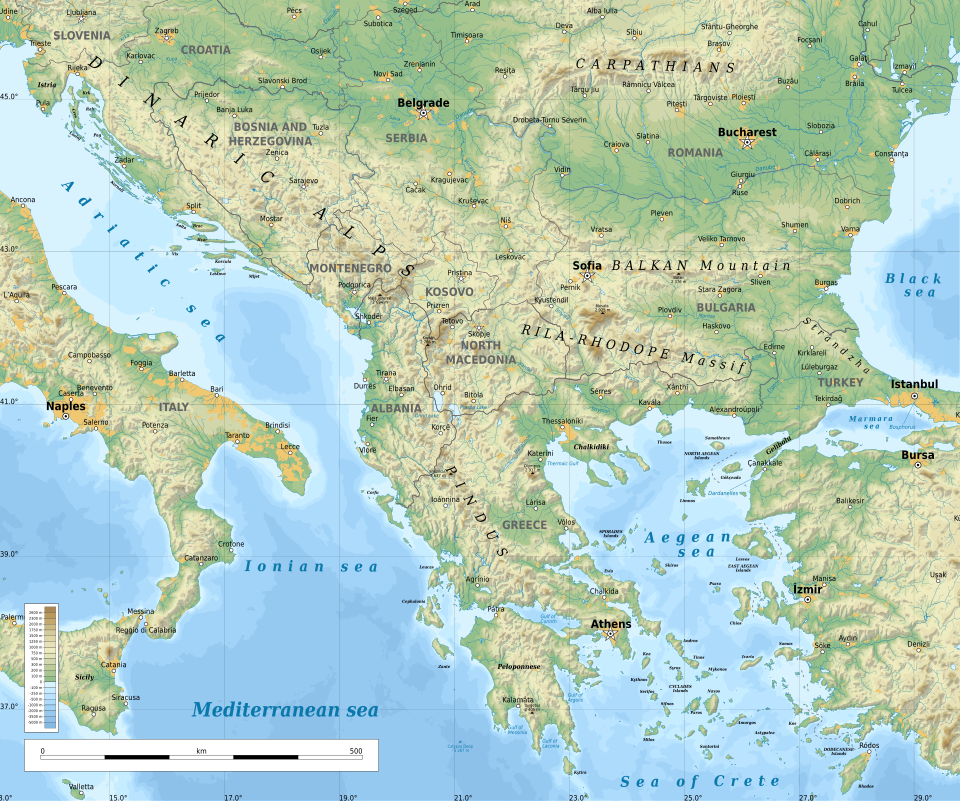
In fact, as of 2026, the only nations in the region who are E.U. member states are Greece, Croatia, Slovenia, Romania, and Bulgaria. As for the first three, these countries are already so historically integrated with Western and Central European institutions that they transcend the case in point. And as for the last two—Romania and Bulgaria—even these nations are hardly fully-fledged members of the economic bloc at all. Even after much delay and even more added domestic turmoil, these states joined the European free trade and customs zone (Schengen Area) just last year…
Of course, more centrally-located post-Communist countries like Poland and Hungary have shown that organizations like the E.U. are generally conducive to precipitating economic prosperity, but in those cloistered Balkan nations where such foreign cooperation would otherwise seem to be a no-brainer, it usually isn’t seen as such.
Perhaps the best explanation is that popular opinion in these places is highly suspicious of alleged “foreign imperialism” disguised as foreign assistance, a belief not representative of what’s happening today but which holds some ground when considering all that the Austrians, Ottomans, Russians, and Italians have done over the centuries in this part of the world… Not to mention what they’ve done to each other.
The geography of the region, which is very mountainous and rugged, also makes these societies inherently more insular compared to the rest of Europe, a reality only exacerbated by the vast economic disparities between the Balkans and everyone else caused by fifty years of Communist rule and an effort to industrialize which began about a century after Western Europe’s. In essence, the cultural and structural disparities between Southeastern Europe and the rest of the continent have long been and continue to be the fundamental obstacle to economic or political integration.
If you’re looking for tangible examples of this disparity, look no further than those events which transpired in Bulgaria in the closing months of 2025. As that nation, an uneasy E.U. member state, initiated an effort to adopt the Euro as an official currency, popular beliefs of foreign conspiracy and corruption between local oligarchs and Brussels led to the resignation of Bulgaria’s then head-of-state Rosen Zhelyazkov. The debate in this nation between self-sovereignty and deeper integration with the E.U. continues to be a roughly 50-50-split issue in the country, as is also the case for many of its neighbors.
Next on the List: Albania:
Albania has long enjoyed a somewhat more well-established relationship with the rest of the continent on account of its proximity to Italy and the wider Mediterranean, a concern for the rights of ethnic Albanians in neighboring Kosovo shared by Western Europeans, and Albania’s rather exceptional status during the Cold War as a Communist but anti-Soviet and non-aligned nation under dictator Enver Hoxha. This may have made its path to accession into NATO in 2009 more grounded on a foreign policy basis, but when it comes to economic and political integration with Westerns institutions more broadly, it faces many of the same obstacles as do its other Balkan neighbors.
In fact, the same suspicion which the Bulgarian public has long (and rightfully) held over government corruption also reigns dominant in Albania. In 1997, the country experienced a crisis called “civil unrest” by some and a “civil war” by others in which revolutionaries forcibly ousted a government that had engaged in extensive pyramid scheming at the people’s expense. Like in Bulgaria’s case, these acts of governmental corruption were and continue to be associated with Western institutions like the European Union, since these elites are often the ones seeking to gain Brussel’s favor in the first place. In Albania’s case, this perceived correlation was further solidified by the West’s explicit support of the Albanian regime which had engaged in such rampant corruption before 1997.
In 2026, Albania once again faces a bout of internal unrest surrounding an extensive government corruption scandal, but this time under the backdrop of the country’s ongoing efforts to join the E.U. In particular, the present-day crisis surrounds the country’s deputy prime minister Belinda Balluku, whose recent conviction of corruption in court was met with prime minister Edi Rama’s near-immediate decision to simply reinstate her in spite of her widespread abuses of power.
Protests throughout mid-February have verged on the violent and called for the outright end of Rama’s government in a pattern not so dissimilar from what was seen in Bulgaria earlier in December. The United States and Europe, who have a vested stake in supporting the government regardless of its abuses, have remained rather silent and, if anything, critical of ongoing violence. For them, keeping an ally in the Western Balkans that enables them to project power into left-over flashpoints from the Yugoslav Wars like Kosovo and Bosnia is far more important than it might sound. Any government shake-up in Tirana, in effect, could leave the nearly 600 US troops in Kosovo meant to keep the Serbs from acting up completely stranded.
The United States and the E.U. still commit serious resources to propping up judicial and civil institutions aimed at combatting corruption in countries like Albania, but the ulterior purpose behind this is political: bringing Albania closer to the West by ultimately admitting it to the E.U. With this process of Western integration almost always being a transactional process between Albanian elites and European bureaucrats, the local public’s perception of the E.U. risks being confounded with the fiscal abuse committed by these same political and economic elites.
And, as Western nations (but most especially the United States) begin to look at foreign affairs from a point of view that is more apathetic to the integrity of democratic institutions in places where they’re already weak, tensions over E.U. accession in the Balkans risk devolving even further. In fact, if the Collective West does not begin to take more substantive efforts to meet the valid concerns of local populations surrounding domestic corruption and the its own disinterest in curbing it, the negative perception Brussels has garnered from mass elements within these nations will become even more widespread.
When negative perceptions like these build in some of Europe’s most peripheral corners, they risk spreading throughout an entire economic bloc that is already second-guessing the E.U.’s claimed ideal of “multilateralism.” With the European Union’s “E5” strongest member states of France, Germany, Spain, Poland, and Italy taking recent measures to usurp greater control over the alliance’s decision-making to make its platform more assertive on the global stage, the opinions of smaller member states risk being further alienated. And, when we consider the already-negative perception of the fiscal policy of the E.U.’s bigger states in respect to past crises like the Greek Debt Crisis, it appears that Western and Central Europe will have to fight an uphill battle to keep the E.U.’s smaller states on its side in the long run.
If it doesn’t do this, not only will the continued expansion of the E.U. be jeopardized, but so too will its prospects of remaining as large as it is today. Recent electoral results in places as diverse as Romania, Hungary, Slovakia, and even Poland have undermined these nations’ very commitment to E.U. policies which are one-sided in the preference to Western Europe. In some cases, like in Hungary or Slovakia, this has even resulted in pro-Russian leanings that could precipitate their departure from the alliance in its entirety.
If the European Union wishes to remain afloat, it will have to come to terms with the vast cultural, economic, and geographic differences which define its numerous member states. If this is impossible or simply outside of Brussel’s control to impact (which in some ways it might be), then there’s little it can do to escape the reality that the economic bloc might just be too big and too overextended. This isn’t a fun idea to entertain, but being aware of it might mitigate some potential irresponsibilities in a changing world full of unforeseen inevitabilities.