

Not a Good Look...
But maybe that's the point

On September 2, 2025, China held its annual “Victory Day” Parade in commemoration of the 80-year anniversary of Japan’s surrender to the Allied Powers in the Second World War. Its important historical basis aside, the ceremony was focused with far more than China’s decade-long struggle with the Japanese Empire in the early 20th century.
A mere century ago, China was a backwards, lawless failed state whose glory days of years past had all but vanished as European, American, and Japanese interests tore the nation at its seams. In the 1930’s, already divided between a dozen rival warlord factions, China soon found itself embroiled in a full-fledged Japanese invasion. Until Japan’s collapse in 1945, virtually all of China would be occupied by the Japanese. While China’s losses were certainly significant and its contributions to the war effort against Japan most certainly not without merit, it was largely American intervention against Japan in 1941 and Soviet intervention in 1945 that saved the country from full occupation.
This narrative differs substantially from that being offered by Xi Jinping and the modern-day Chinese Communist Party. To the modern statesmen in Beijing, China stood, so to speak, “alone against fascism” as their Russian counterparts like to claim as well. To understate the losses and contributions of the Chinese against Japan would be both inaccurate and inappropriate, but the “sole victory” against Japan which has been flaunted by the Chinese Communist Party has in turn been used to justify China’s position as an equal architect in the post-WW2 world order in which it became a permanent member of the UN Security Council alongside France, Britain, America, and Russia.
And so, in a sense, the legacy of World War II itself is not what concerns China. What does, on the other hand, is the notion that China is just as established of a “great power” in the modern-day world as are its counterparts—preponderantly because of their “total” victory against Japan in 1945. And from this basis, it believes that it can assert itself as an alternative to the rampant unipolarization of global politics which has become dominant since the collapse of the Soviet Union in 1991. In light of the convenient development of political volatility in Washington, Xi has claimed that China represents a beacon of stability for nations which seek to gain independence and assert their sovereignty in a world free of American hegemony.
Quite frankly, it is no surprise that China’s claims of a fair and multipolar world (i.e., understated Chinese global dominance) represent an appealing alternative to the West for nations of the Global South that seek to evade Western idealism and what they see as “neo-colonialism.” The BRICS, Shanghai Cooperation Organization, and the general economic emergence of the Global South have all raised American apprehensions of a new global bloc led by China moving against the West, and the recent military parade in China only augmented these existing concerns.
However, as with any authoritarian nation, there’s more to the situation than what the ruling party portrays. It is thus crucial to take a step back and reflect on what China’s recent and unprecedented show of military force actually shows. In many ways, it may be a quite different reality from that which Xi likes to talk of ad nauseam.
China and its “Friends:”
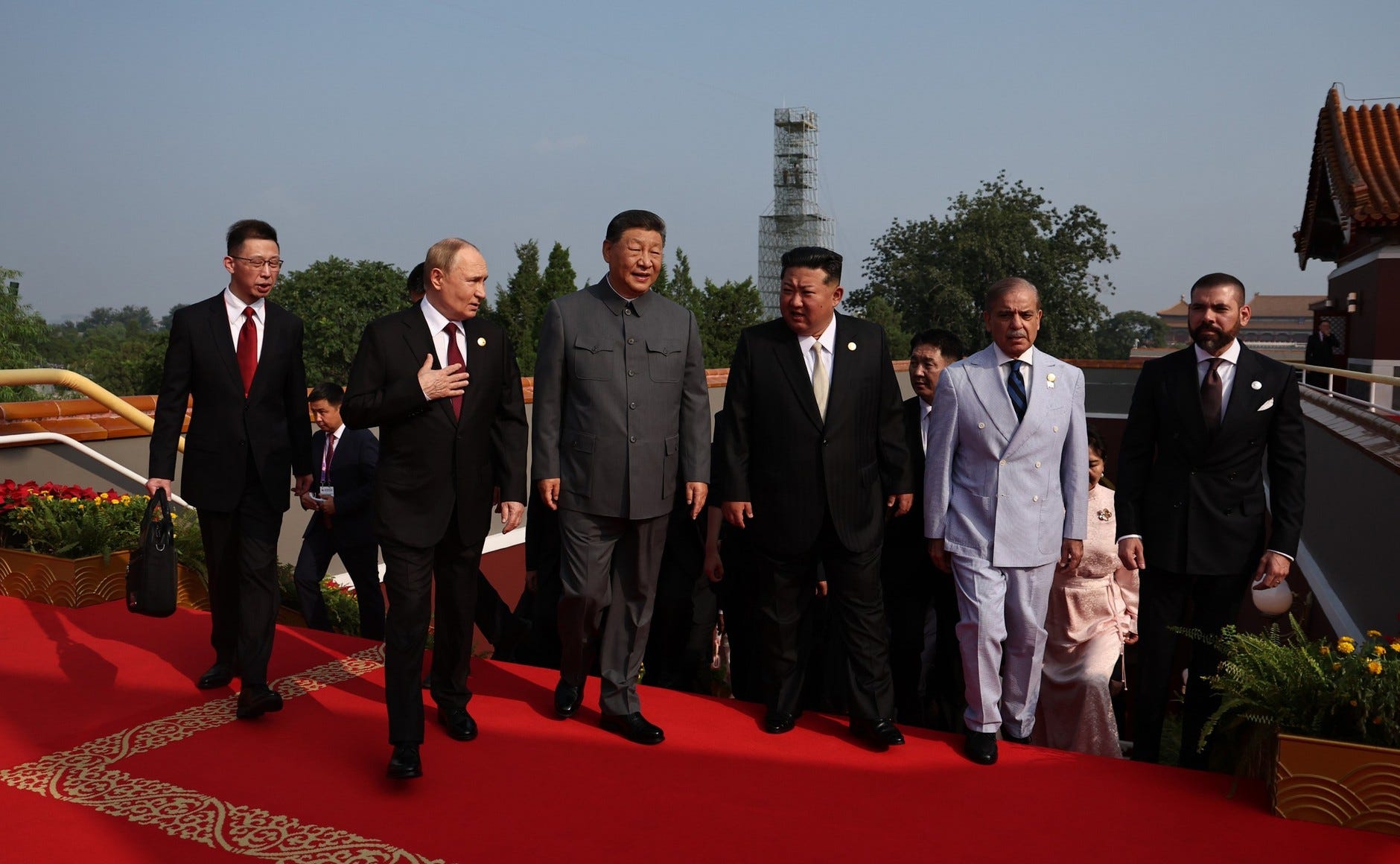
Xi’s Victory Day Parade makes clear a variety of both accuracies and fallacies. For one, there can be no mistake that China’s extraordinary economic and political growth in the past twenty years have been consolidated. The nation is an unmistakable “Great Power” that now stands as the clear successor to the position Russia once held as America’s greatest rival. The large array of foreign dignitaries present in Beijing tangibly revealed the diplomatic leverage it now holds over parts of Asia, Africa, and elsewhere.
Yet, it is in this very fact that the realities of China’s international situation begin to break down. Apart from some obvious pariah states like Iran, Russia, and North Korea, the presence of dignitaries from elsewhere is just as symptomatic of general multipolarization as it is of China’s rise as a global power. For nations that simply seek to hedge their status as a neutral nation and to gain leverage from both China and the West, “playing both sides” is the order of the day. This doesn’t reflect a shift in the East-West “balance of power,” but rather the growing assertiveness of those who lie outside of both spheres.
And then there’s the elephant in the room: India. Trump’s imposition of secondary tariffs on India for its purchasing of Russian oil and gas has precipitated a political scuffle between the two major powers. Yet, Modi’s presence at the annual Shanghai Cooperation Organization (SCO) meeting last week in Tianjin prior to the Victory Day Parade in Beijing really had nothing to do with China at all.
India and China have been, are, and will likely continue to be unreconcilable enemies for the long-term future. Unless Washington engages in some abomination of foreign policy that forces India to situationally align with Beijing, this status quo will remain the same. India and China possess disputes regarding territory and political influence in South Asia and the Tibet region that have been prone to precipitate full-scale war between the two nations, and China’s close ties with Pakistan make any form of rapprochement impossible. In terms of economics, India and China are arch rivals when it comes to the production of consumer goods for global markets. China and India are, quite simply, natural rivals in almost every regard.
So then, why was Modi in China last week? The answer lies in his country’s difficult political situation at the present moment. India finds itself trying to preserve its relationship with Russia, yet the imposition of American economic penalties for this very association has pushed the nation into a difficult corner. On one hand, it is trying to assert its geopolitical autonomy between East and West, while on the other hand it is trying to avoid upsetting either side. By visiting China, Modi seeks to show Trump that his nation cannot be “pushed around” and can take matters into its own hands if Washington does not pursue a compromise. It is not a reset of India-U.S. relations, but rather an effort by India to gain more leverage in perhaps its most important diplomatic partnership.
The Tip of the Iceberg:
It’s quite clear that China’s seemingly decked-out array of “allies” is not as genuine as it appears at the surface. China possesses very few “natural” allies, and even the close ties between itself and Russia are anything but indestructible. It, too, is a partnership of geopolitical convenience.
It is also rather typical of Great Powers to flaunt a perception of strength at times of great stagnation or decline. America certainly lacks a strong track record in foreign policy, but the alliances it does possess are century-spanning and, for all intensive purposes, indestructible outside of the possibility for long-term policy shifts. China faces quite the opposite situation. Like the Soviet Union in the 1980’s, it possesses very little soft power where it counts, and the allies it does possess—all of which are essentially the world’s outcasts— would just as quickly turn on Beijing as they came flocking to it.
I mean not to directly compare Communist China in 2025 to Soviet Russia in 1985, but any notion of future Chinese global hegemony is absurd at best. The nation faces economic stagnation of the likes of Japan in the late 20th century, a trade war with Washington that it cannot hope to win, global partnerships that are rooted in short-term sentiments rather than long-term commitments, and a growing realization that, perhaps, its heyday as an economic giant is already waning.
Looks can and often are deceiving. The image of power and stability which Beijing is trying so hard to illustrate is largely meant to cover the growing cracks in the country’s foundations. Whether those cracks will grow, or show themselves anytime soon, is another question.