

Pokrovsk, Ukraine
A Case Study on Territorial Irrelevance

After almost three years of war in Eastern Ukraine, it has become quite clear that the defining factors of the conflict lie far from the notion of territory.
Ever since the rapid Russian advance in early 2022 and the rapid Ukrainian counterattack in mid-2022, the frontline has stalled along a line in the nation’s South and East. Russia has hence embarked on a relentless ground assault aimed at conquering the northern and western quadrants of the Donetsk Oblast, an operation which has yielded some minor gains at a devastating loss of manpower. Quite a “Pyrrhic Victory,” one might say.
To date, Russia controls roughly 20% of Ukraine’s territory. While this metric is certainly significant, Russia has yet to capture any of Ukraine’s great eastern cities like Odessa, Kharkov, or Zaporizhzhia. And, the control of these territories does not even align with the strategic impetus for Russia’s invasion in the first place: ensuring that Ukraine remained out of NATO and within Russia’s sphere of influence.
The first phase of the war clearly manifested this intention, but its subsequent failure to capture Kyiv has forced the Kremlin to concentrate on territory rather than regime change. It’s not a favorable approach, but it provides Putin with the only other possible thing to show for his “special military operation.” And, if it worked with Crimea in 2014, what’s the harm in trying it again? Right? Not exactly…
Because Russia’s military efforts have naturally been concentrated on the issue of territory, it has become quite easy for a detached observer to discard the true driving forces behind the war in Ukraine. In fact, if Ukraine were to willingly give up all the Oblasts (provinces) which Russia has formally claimed, and some more, it still wouldn’t be enough for Putin if Ukraine got NATO membership in exchange for such a deal.
Russia knows its slow military advances are unsustainable—it would take decades at this pace of advance for them to even reach Kyiv. Alternatively, Moscow probably thinks that its slow and brutal advances will wear out the Ukrainians (and the diplomatic resolve of the West) before they themselves are worn out. This is why the real importance behind the Ukraine conflict lies not just in the Donbas, but also in America’s bilateral relations with Ukraine and Russia, respectively.
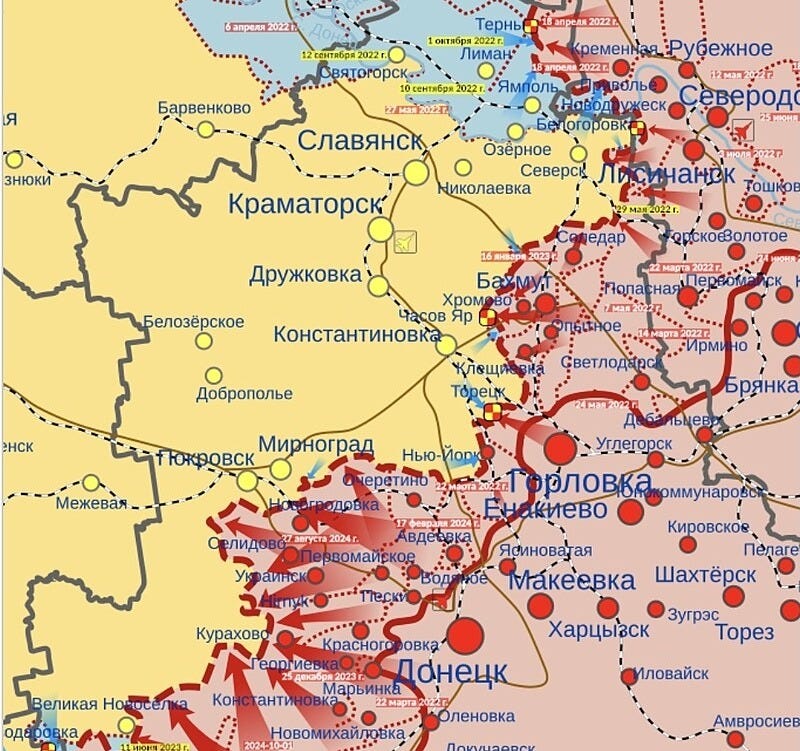
Pokrovsk: A Case Study on Territorial Irrelevance:
Nonetheless, addressing developments on the battlefield—particularly in the critically contested Donetsk Oblast—has its merits. Over the past year, Russia’s forces have been slowly approaching the “fortress belt” of Donetsk, a series of heavily-industrialized, mid-size cities that constitute the foundation of Ukraine’s entire frontline defense scheme. These cities are Pokrovsk, Mirnohrad, Konstantinovka, Druzhkovka, Kramatorsk, and Slavyansk. The seizure of all of these cities has been the primary strategic objective of the Russians for almost two years. So far, they have captured none of them.
That is, until now. Over the past year, the Russian military has been slowly advancing towards the twin cities of Pokrovsk and Mirnohrad. Their entire “summer offensive” was dedicated to their capture—an operation defined by appalling casualties and underwhelming results. A few months ago, they reached the outskirts of both cities, only to engage in yet another round of grueling street-to-street combat. As November rolls on, Russia now controls most of Pokrovsk and is close to encircling Mirnohrad.
We can consider these two cities to be lost causes for the Ukrainians, yet the fighting in and around these cities’ outskirts will likely continue well into the winter and potentially into the spring of 2026.
The capture of Pokrovsk, a city with a pre-war population comparable to that of Gulfport, Mississippi (60,000), is the biggest P.R. victory Russia has to show for over a year of fighting. If Russia were viewing this victory on a strictly territorial basis, they’d be out of their minds.
If it takes a year and 100,000 young lives to capture just two of these small cities, it would likely take 3 or 4 more years, and an untold number of lives, to take the entire “fortress belt.” Do these losses seem a little out-of-scale for the conquest of a province that’s 4-times smaller than Belgium? I’m sure the Russians are sensible enough to understand this, which leads us back to the first point…
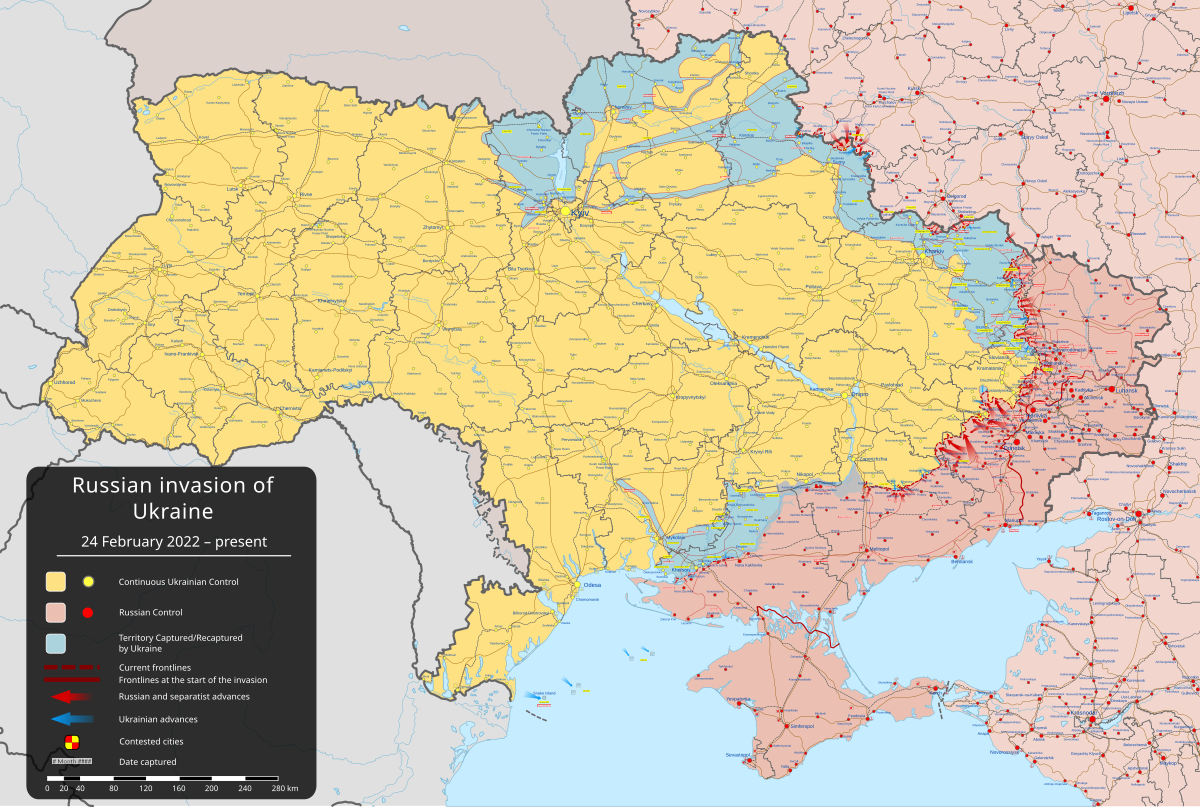
All of this does not necessarily suggest who is going to “win” this war—that is an entirely different question. What it does show is how negligible the issue of territory is to this conflict. What does matter, on the other hand, is the willpower and capacity to keep fighting.
If the capture of Pokrovsk hinders Ukraine’s resolve to keep fighting or makes the West hawkish all-of-a-sudden, then we could definitely rule it as a major victory for Russia. But if it doesn’t, then nothing really changes in the grand scheme of things.
So, for individuals seeking to understand how this war might unfold, don’t get too tied up in watching the battlefield. If you did that for World War I, you’d think Germany was beating France the whole time. Rather, focus on the political endurance of Kyiv, Moscow, Washington, and Brussels. Focus on economic figures, popular opinion, national resolve, and the wider picture of the “Balance of Power.”
The answers to some of these questions will not be revealed until this is all said and done, but knowing where to look and where not to look is certainly a great place to start.