

The Ceasefire That Isn't?
Understanding the mounting crisis between Israel and Lebanon

Lebanon, the small Levantine nation bordering Israel to the south, Syria to the east, and the Mediterranean to the west, was once one of the Middle East’s most prosperous nations. Its capital of Beirut was called the “Paris of the Middle East” that led the region in tourism and foreign investment before Dubai was even on the map.
Lebanon’s fortunes took a tragic reversal in 1975 when the rivalry between the country’s relatively proportional Christian and Shia Muslim populations escalated into a brutal civil war that would last for 15 years. Civil authority collapsed, sectarian violence triumphed, and a dangerous vacuum for non-governmental paramilitaries was formed.
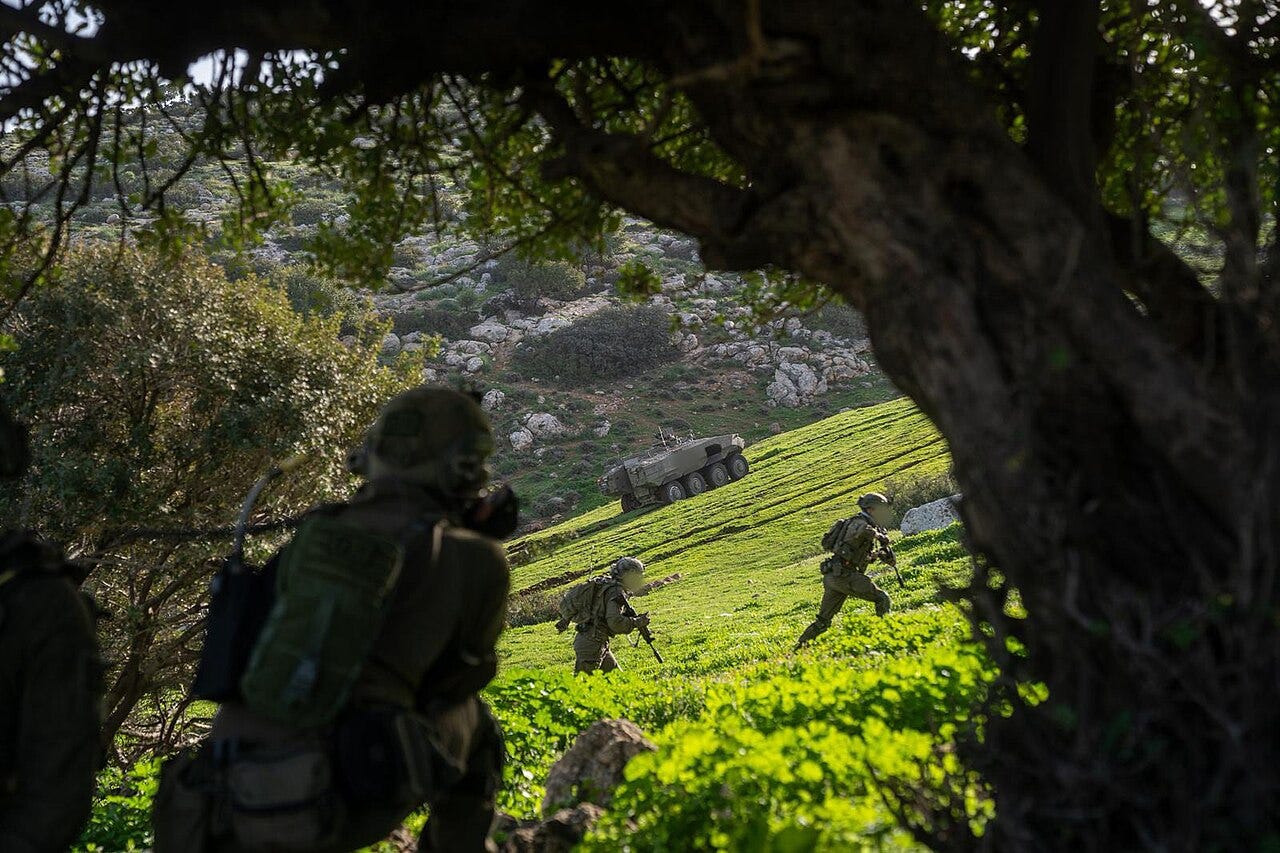
The collapse of civil authority in Lebanon ran adjacent to Iranian Revolution of 1978-1979, which saw the Islamist regime emerge as the dominant force within Iran. While Lebanon lay over 2,000 km from the new regime in Tehran, the fates of both countries would soon become inextricably tied with one another as Islamist Iran sought to form a foreign policy strategy of its own.
After Iraq’s full-scale invasion of Iran in 1980, Tehran adopted a policy of “forward defense” that would in theory promote their ideologically-expansionist aims throughout the Middle East while also creating a buffer between themselves and regional adversaries that lay beyond Iran’s territorial frontiers. For Shia-majority Iran, the largely Shia and effectively ungoverned nation of Lebanon stood as an appealing nation through which to pursue this strategy.
The Islamic Republic’s policy of “forward defense” culminated in the formation of the pro-Iranian proxy militia of Hezbollah within Lebanon in 1982, which was able to quickly gain power within the country with the help of profuse Iranian funding, mounting radicalization within Lebanese society, and the lack of a central government in Beirut to challenge the new paramilitary group.
In the ensuing decades, Hezbollah’s strength would multiply as Tehran’s “Axis of Resistance” permeated the upper Middle-East. The critically-destabilizing vacuum that formed in Iraq after America’s invasion of 2003, for instance, allowed Iranian paramilitaries to extend their influence farther west than ever before. When Syria followed suit in 2011, a land bridge through the war-torn Fertile Crescent was established between Iran and Lebanon. Many have considered Hezbollah to be the strongest political force within Lebanon since 2000, and Hezbollah ministers have even sat within Lebanon’s official executive cabinet since 2005.
Into the Present Day…
As a pro-Iranian and hence anti-Israeli organization, Hezbollah has unwillingly dragged Lebanon into numerous foreign conflicts over the past fifty years. Since 1978, the Israelis have intervened against Lebanon six times in varying forms, the latest of which was launched in conjunction with the US-Israeli assault on Hezbollah’s Iranian patrons in late February. This has all occurred under the backdrop of a Lebanese government that wants to be geopolitically non-aligned more than anything else.
Ever since the Hamas attacks against Israel on October 7th, 2023, the Israelis have adopted a significantly more hardline stance on the ballistic missile threat which Hezbollah has long posed to major population centers in Northern Israel. The IDF took unprecedented measures to weaken Hezbollah through the assassination of the organization’s seven leading executives and the detonation of hundreds of sabotaged pager devices in 2024, two events which precipitated a limited invasion of Southern Lebanon in that same year.
While it is important to remember that Israel is simply fighting the Hezbollah faction rooted within Lebanon rather than the Lebanese government itself, the IDF’s efforts to dismantle the paramilitary group typically come at the territorial, economic, and humanitarian expense of Lebanon as a whole as well.
Amidst its concurrent efforts to dismantle the Iranian regime, Israel has once more escalated its operations against Hezbollah, first with an expanded ground offensive into Southern Lebanon and then through “Operation Eternal Darkness,” in which the IDF launched crippling airstrikes against the Lebanese capital of Beirut on April 8th. These strikes killed close to 400 civilians, earning the day the name “Black Wednesday” within Lebanon and abroad. This event— among others— underscores the reality that Lebanese non-alignment is not enough to escape the fact that Hezbollah lives rent-free on its very territory, often resulting in widespread collateral damage.
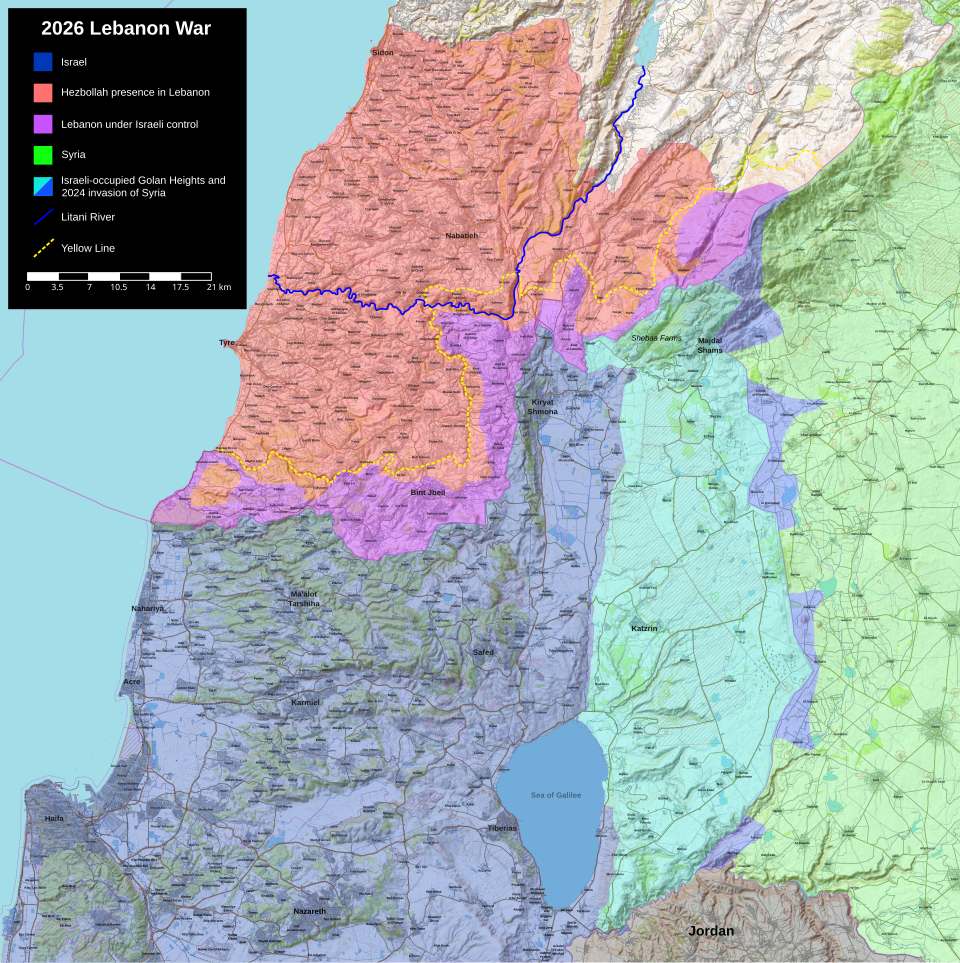
As foreign parties like Pakistan, Turkey, Egypt, and the United States have tried to work towards a ceasefire with Iran, the Israelis have asserted that their ongoing offensive in southern Lebanon lies outside the scope of the peace talks. Then on April 16, after mounting pressure from Washington to de-escalate, Israel reluctantly signed on to a ceasefire agreement with Lebanon that has only held true in name as both the IDF and Hezbollah continue to exchange fire. As recently as April 26th, for instance, over a dozen in Lebanon were killed by an Israeli strike against Hezbollah targets.
Lebanon: Caught in the Crossfire:
Lebanon’s weak central government has sought to purge Hezbollah from the country for decades, but it also knows that doing so in a way that would come at the expense of public support could worsen the tense sectarian divides between Shia Muslims and Christians. While Hezbollah’s relative decline in recent years has allowed for Beirut to reconsolidate some its influence within the militia’s heartlands in southern Lebanon, the government is still faced with one over-arching paradox: its territory is being used as a battleground for a war it isn’t part of.
Hezbollah is by no means endorsed by the Lebanese government, but when foreign parties like Israel have tried to dismantle the group, they have had to invade Lebanese territory in the process. So, while Lebanon and Israel might nominally share the collective goal of disarming Hezbollah, Lebanon often suffers from Israel’s lack of restraint against the paramilitary group because these efforts involve the undermining of Lebanon’s very own territorial sovereignty. In an era where Hezbollah can no longer count on Iranian financial assistance, conflict with a foreign party like Israel also gives Hezbollah a perceived “justification” to exist within the eyes of those caught in the crossfire in Southern Lebanon.
The paradox which underscores this uncomfortable reality is one of mutual exclusivity: Israel’s strikes against Hezbollah might weaken the militia, but they also weaken Lebanon. Beirut thus requires restraint from the Israelis to do the dirty work themselves and on “their own terms” in a way that would not involve unsolicited airstrikes or armed incursions from foreign parties. At the same time, however, Israel has proven itself completely unwilling to dial back its campaign against Hezbollah, thus leaving Beirut in an unsolvable dilemma whose reckoning a ceasefire can only defer.
For its part, Israel has strategic rationale behind its campaign against Hezbollah. Tens of thousands of Israeli citizens have been forced to flee the country’s north because of the militia’s large stockpiles of missiles and drones that it has proven itself more than willing to use in the past. However, as the neutral country of Lebanon (not Hezbollah) continues to bear the collateral damage from Israel’s war against Hezbollah, popular and elite opinion will begin to question Israel’s motives both in the region and abroad. This obviously puts Israel’s relationship with much of the Arab world on an uneasy footing, but in recent weeks it has even prompted the Americans and Europeans to call out Israel’s recent ground and aerial operations.
Is There Cause for Hope?
As problematic as the Israel-Lebanon dynamic might be, there might be some light at the end of the tunnel. In mid-April, delegations from both Lebanon and Israel initiated direct ceasefire talks for the first time in modern history, a step which could lead to the disarming of Hezbollah through reciprocal cooperation rather than through unilateral and uncoordinated assertiveness from either side.
The good news is that both Israel and the Lebanese government have the same ends in mind for Hezbollah, but at the present moment the means by which both seek to achieve this goal have precipitated acute instability and has seriously worsened the political and humanitarian outlook of Lebanon. While failed diplomatic initiatives are no stranger to the Middle East, the ongoing talks between both parties do have the potential to infuse a greater sense of direction, coordination, and purpose into a hotbed for conflict that has persisted for half a century. In an ideal scenario, this would bring the Israel-Lebanon-Syria region into a state of mutual coexistence and stability unlike anything it has ever seen before.
With Hezbollah’s Iranian lifeline now in serious jeopardy, such coordination might very well be the decisive blow needed to topple an organization that has wreaked havoc across the Levant for decades and prevented Lebanon from yielding the civil prosperity it once commanded.
Highly informative!