

The Polish-Soviet War, Part II
The capture of Wilno and the Polish-Ukrainian Alliance of 1920

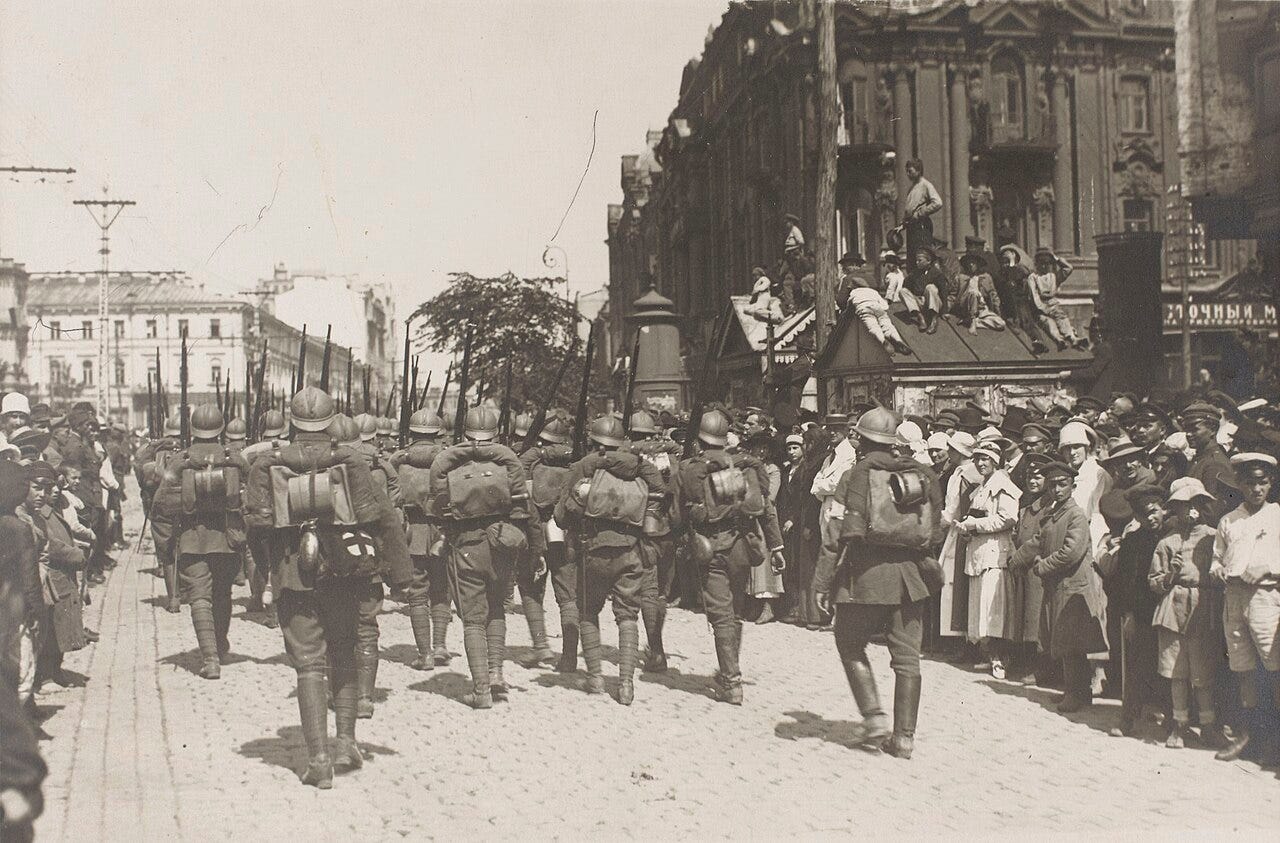
This is the second part in my inaugural Historical Digressions essay series on the Polish-Soviet War of 1919-1921. To read the first part, click HERE.
By the start of 1919, the Polish army stood poised to strike against a Red Army that was rapidly consuming many of Eastern Europe’s newly independent states, including Lithuania, Ukraine, and Belarus. After the Second Polish Republic had emerged under the leadership of Józef Piłsudski in 1918, Warsaw believed that its future security could only be guaranteed if the sovereignty of its non-Russian neighbors to the east were as well. As we’ve discussed, the ideological corollary of this strategic necessity was the Intermarium ideal, which stipulated the creation of a bloc of militarily and politically aligned nations in Eastern and Central Europe in order to deter future Soviet aggression by means of collective security. The outward manifestation of this philosophy was Poland’s rapid military advance into the Polish-Russian borderlands in early 1919 to come to the aid of those countries whose capitulation to the Red Army would have otherwise been inevitable. It is in this strategic and ideological convergence of interests that the Polish Soviet War first ignited.
The Initial Polish Offensive (January 1919- April 1920)
While Soviet Russia had advanced into parts of Lithuania and Belarus by late 1919, its control over these regions was tenuous at best. The Red Army was far more concerned with the ongoing struggle against the White Russian Army on other fronts, leading to Poland’s quick capture of key Soviet strongholds in the Borderlands throughout 1919 after an initial engagement at the town of Bereza Kartuska in Western Belarus in February of that year.1
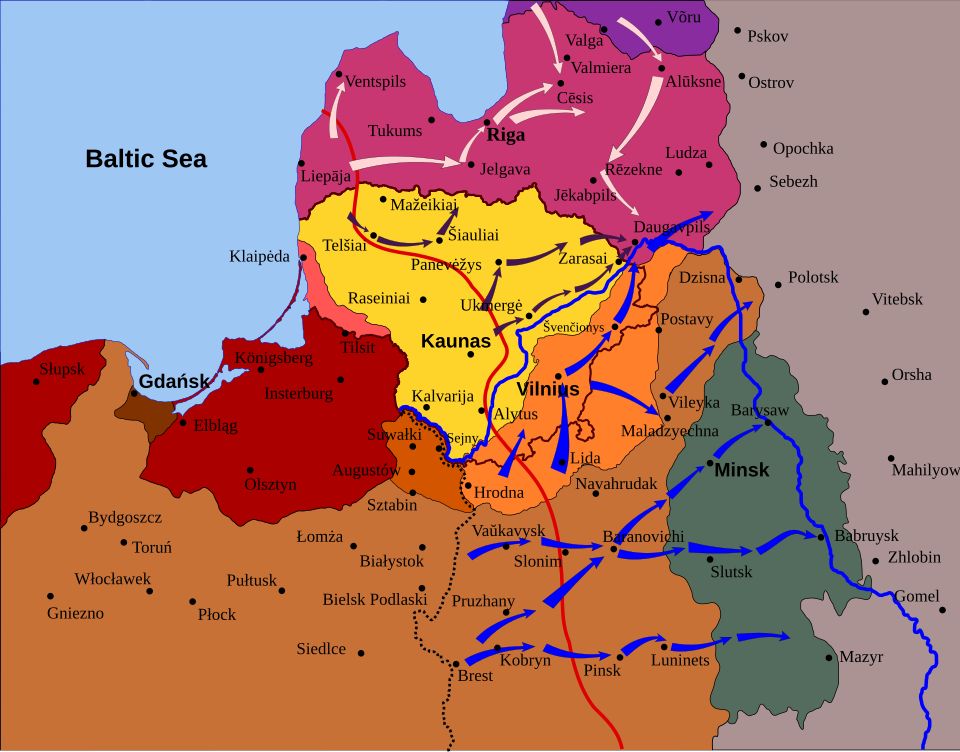
With the subsequent captures of Wilno and Minsk— the largest cities of Lithuania and Belarus respectively— Piłsudski’s aspirations for an Intermarium state had already come shockingly closer to fruition. When the legions of Piłsudski marched into Wilno, the Polish leader was quick to issue his “Proclamation to the Inhabitants of the Former Grand-Duchy of Lithuania,” a statement which would set an important precedent in Poland’s policies towards its captured territories under the guidance of the Intermarium framework. While Piłsudski’s proclamation primarily emphasizes the unprecedented victory of the Polish army against a much larger Soviet adversary, portions of the address certainly reflect the the federalistic ideology which were actively influencing Poland’s actions in the broader region:
For more than a century your country has known no freedom. It has been oppressed by the hostile force of Germans, Russians, and Bolsheviks, who, whilst never consulting the population, imposed alien codes of conduct which frustrated your wants and interrupted your way of life. I, who was born in this unhappy land, am well acquainted with its state of perpetual subjection, a state which must be removed once and for all. Now at last, in this land which God seemed to have forsaken, liberty must reign, with the right of full and unrestricted expression of aspirations and needs. The Polish Army brings Liberty and Freedom to you all. It is an army which I led here in person to expel the rule of force and violence, and to abolish governments which are contrary to the will of the people.2
Piłsudski is quick to point out the Russian oppression which had long characterized Lithuania’s existence in a reflection of his Prometheist values. Furthermore, Piłsudski’s similar experiences under Russian rule as an ethnic Pole establish a clear affinity between the peoples Poland and Lithuania, both of which he thought ought work together–and ultimately unite– in their shared desire to end decades of Russian subjugation.
The Intermarium in Action: Poland’s Ukrainian Alliance:
Throughout late 1919 and early 1920, little changed along the Russo-Polish frontlines. Some token offers for peace were made, yet out of distrust and a lack of initiative from all parties involved, no agreement was reached. At this point in time, Piłsudski was quick to realize that his nation was faced with a critical inflection point in its military outlook.
The White Army of General Denikin had been decimated by the Bolsheviks in the previous year, putting both the prospects of a non-communist Russia and of an independent Ukraine in severe jeopardy.3 It must be remembered that, in accordance with his federal aims, the principal goal of Piłsudski in attacking Russia during the previous year had been to prevent it from re-occupying the non-Russian peoples of the Borderlands, all of whom Poland sought to incorporate into a multi-ethnic federation of its own. As Ukraine found itself once more at the verge of destruction in 1919, the basis for Poland’s foreign policy was significantly compromised.
Throughout all of Eastern Europe, Ukraine was probably the most coveted nation by foreign parties. It commanded the largest industrial base east of Germany and one of the largest supplies of foodstuffs anywhere on the planet. And thus, Ukraine was the very hinge on which a Polish Federation would hinge. In his book White Eagle, Red Star, Norman Davies described such a prospect as follows:
With the Ukraine, Soviet Russia could reforge the economic and political predominance of the Tsarist Empire; without it, she would be reduced to a shivering northern rump, incapable of feeding and equipping her people. With the Ukraine, Piłsudski’s Border Federation had a real chance at prosperity and survival. Poland, as a chief sponsor, could command a network of trade and commerce stretching from Finland to the Near East. Poland might recover the glory of her medieval past when, or so the story goes, as arbiter of a realm vaster than the Holy Roman Empire, she ruled over Cossacks and Tartars and drove the cringing princes of Muscovy to their lair. Without the Ukraine, the Border States would be so many barbs on an Allied fence.
Truly, the fate of Poland’s future–and of Soviet Russia’s–hinged on the control of the lands of Central and Eastern Ukraine. It was in this frame of mind, combined with the appalling advances of the Reds in the winter of 1919, that convinced Piłsudski that his best opportunity to make a move against Moscow would be in the spring of 1920.
However, any prospect as ambitious as capturing Ukraine would require Piłsudski to find one or more partners in such a venture. Of course, the Western powers would be of no use given geographic detachment, but efforts were made by the Polish foreign office to work with neighboring states that bore similar concerns over Soviet expansion and were seen as natural beneficiaries of Pilsudski’s Intermarium framework.
In September of 1919, Piłsudski had sent General Karnicki to explore possibilities of collaboration with Denikin’s Russian forces. However, it quickly became clear that Denikin’s belief of an “indivisible” Russia of the Tsarist type would be incompatible with even Poland’s own sovereignty, let alone endorsing its efforts to dismantle Russia’s former empire.
At the Conference of Baltic States in Helsinki, Piłsudski received more encouraging rhetoric. Piłsudski’s longtime friend and then-President of Finland Gustav Mannerheim was receptive to collaboration against the Bolsheviks, as were the Latvians. In Estonia, which had just signed an armistice with the Bolsheviks, Piłsudski was met with skepticism, and from the Lithuanians he only received hostility on account of the ongoing dispute over Wilno’s future territorial fate. Ultimately, while some of Northern Europe’s states resonated with the Poles, none were ultimately willing to translate such approval into full-fledged war against the Red Army
In January of 1920, Piłsudski advocated for concerted intervention in a meeting with the Romanian foreign minister Take Ionescu. While sympathetic and supportive of Poland’s cause, the Romanians remained hesitant to engage in further military ventures after their most recent military engagements in Transylvania and Hungary.
In February, Piłsudski would send Titus Flipowitz to the Caucasus to explore avenues of cooperation with the Menshevik governments in Georgia and Armenia, yet all he would find was a faction at the verge of capitulation to the Red Army. In fact, after the Soviet conquest of Azerbaijan in April, Georgia and Armenia would find themselves permanently stranded and facing certain capitulation, making any question of cooperation with a nation on the other side of the Black Sea a mere absurdity.
And, having exhausted nearly all his options, Piłsudski was left to cooperate with the weakest of all candidates: the Ukrainians themselves, then led by Semyon Petliura and the Ukrainian People’s Republic. While collaboration between Piłsudski and his Ukrainian counterpart was inevitable, the weakness of Petliura’s forces was in many ways inconvenient to the Poles. Throughout the summer and winter of 1919, the Ukrainian People’s Republic had been decimated by Denikin’s assault on Kyiv and his attempted march on Moscow. When the Soviets came storming southward only months later, Petliura’s already-embattled forces were subjected to another bout of near-total annihilation.
Despite his shortcomings, Petliura had one advantage: he existed. As a feasible leader for Ukrainian nationalists to rally around, Piłsudski understood that the weakened figure, if rehabilitated with Polish manpower, would be his most viable candidate in pursuing a full campaign of liberation of Ukraine. And thus, by necessity of the upcoming Polish operation into Ukraine, an agreement between Piłsudski and Petliura was made on the 21st of April, 1920.
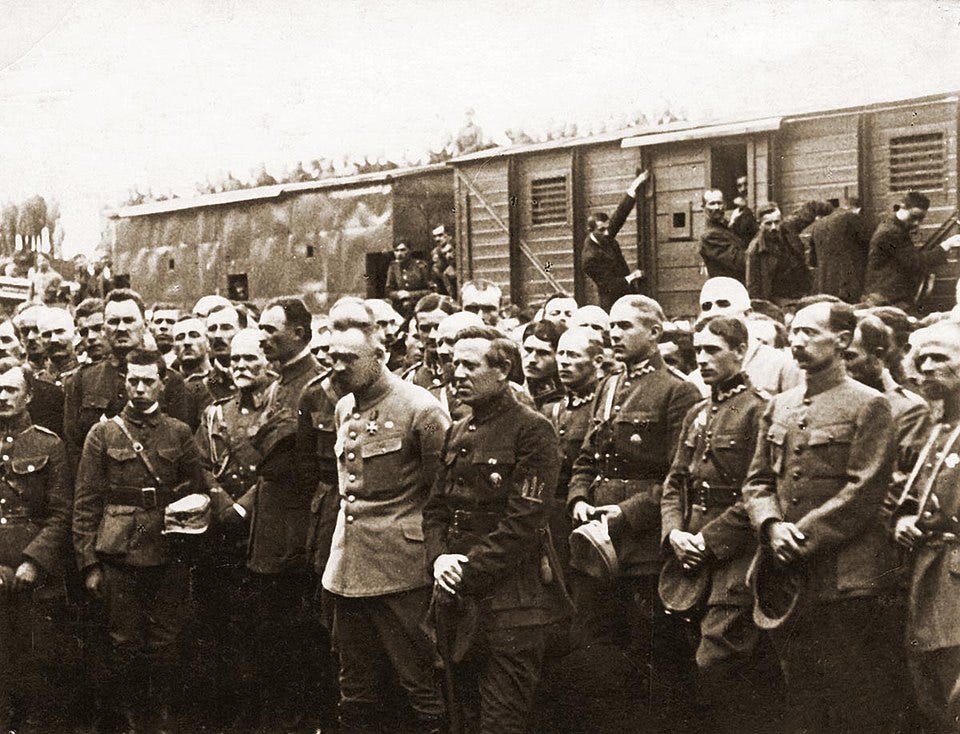
The Polish-Ukrainian agreement was comprehensive in its call for military collaboration and, while not initially enacted, extensive economic collaboration. According to one such draft, the Poles and Ukrainians would establish a free-trade zone, an integrated railway network, and even a Vistula-Dnieper waterway. The Poles were to also gain concessions at several major iron mines in Krivoy Rog and at the port cities of Odessa, Nikolayev, and Kherson along the Black Sea. These concessions, while certainly not subjugating Ukraine to the status of a vassal state, undoubtedly held the riches which would define the success of Piłsudski’s federal state.
In the Polish-Ukrainian treaty, we can perhaps see the greatest manifestation of Poland’s federalist Intermarium approach. While Poland and Ukraine were to recognize one other on the basis of the “inalienable right to self determination,” the two states would be unified in their economic, military, and political apparatus so as to preserve their collective sovereignty from the Soviets.
Of course, the Ukrainians were to be subservient to the Polish Republic in any such arrangement. Most notably, Petliura was forced to recognize Poland’s gains from its conquest of the Republic of Western Ukraine—an entirely different political entity—during the previous year. Nevertheless, it is understandable that Petliura, who found himself in a near-terminal political crisis in 1919, would have agreed to such terms as a means of mere survival, and as such, the understanding of Polish leadership was implicitly and universally codified. Poland had, in effect, destroyed one Ukrainian state in the previous year so that it could form a new one on its own terms.4
The “Kyiv Expedition” of 1920:
With the political and diplomatic arrangements now in effect, Piłsudski ordered the “Kyiv Operation” to begin on the 22nd of April. From their frontier positions in Rowne and Novograd-Volynsk, the armies of General Smygly-Rydz, Iwaszkiewicz, and Listowski were to make a rapid advance towards the Dnieper River, culminating in the capture of the Ukrainian capital of Kyiv. On the flat and sparsely populated terrain of Central Ukraine, light cavalry would allow for the Poles to quickly outmaneuvre the watered-down Soviet forces along the Western front.
On the eve of the Polish attack, the Soviets found themselves mired in domestic unrest and a large mutiny among their Ukrainian divisions. From the Red Army’s rear, remnants of Denikin’s White Army remained highly active in West-Central Ukraine, as did Hester Makhno’s notorious Anarchist revolutionaries in the Donbas. By the time the Poles had initiated their advance, the Soviets stood little chance at resisting. Smygly-Rydz reached Zhitomir on April 26th, crossing a shocking fifty five miles in only twenty four hours with the help of Poland’s famed light cavalry. To the north and south, the situation was equally problematic for the Reds. From Polesie in Byelorussia, the Poles took Chernobyl just a few miles north of Kyiv.
For the Reds, the offensive proved to be a complete and utter rout. Several divisions suffered losses as high as 40%, and much of the Western front was forced to abandon its artillery and heavy equipment in the wake of the Polish advance.5
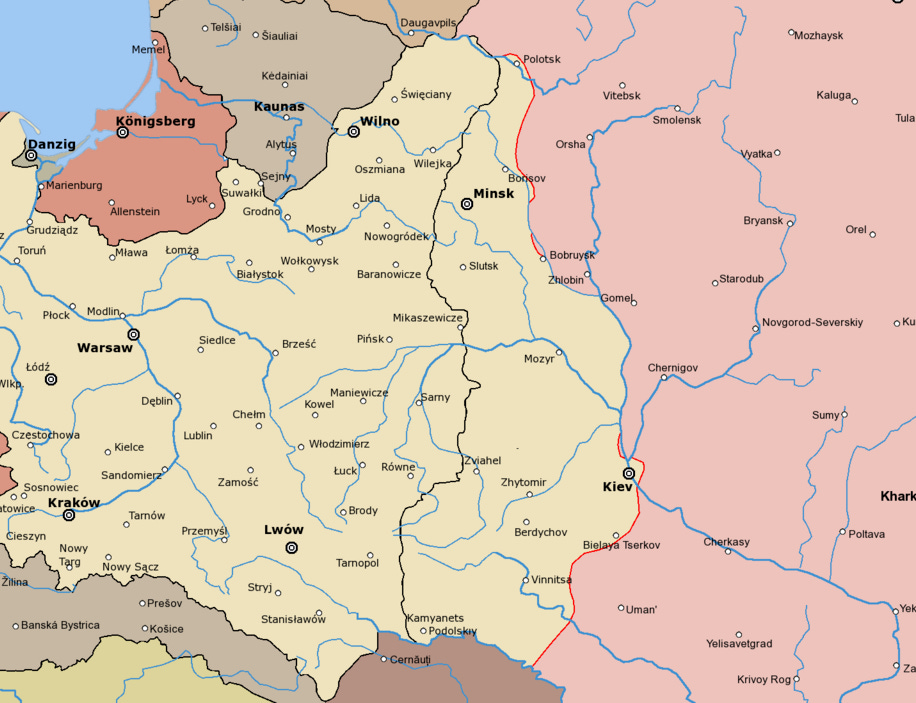
After a week’s pause to regroup their forces, the Polish cavalry advance continued with a rapid pace towards Kyiv. By May 3rd, Polish Hussars had penetrated the suburbs of the city, and on May 6th, all Soviet forces had fled beyond the Dnieper river. On the following day, Polish units arrived at the city center and declared Kyiv to be liberated in what had been Poland’s greatest victory against the Bolsheviks thus far and the first Polish conquest of the city in over two hundred years.
Piłsudski’s victory, however, was not as one-sided nor decisive as he had hoped. Recognizing their forces to be inferior to the Poles, the Soviets had withdrawn from the Kyiv region before the Poles could engage with them in a potentially-decisive confrontation. The Red Army, as pitiful as it may have been, was largely intact. If the Poles decided to remain along the Dnieper for the rest of the summer, their momentum would likely be transferred back to a reorganized Soviet force, and if they were to continue, there was nothing which they could possibly capture between themselves and Moscow other than the wide open Steppe. All they could do was wait for the inevitable Soviet counterattack, which would likely reflect Moscow’s outrage over the conquest of what they saw as the “mother of all Russian cities.”
From its onset, the Polish-Soviet War would exemplify several tenets of Polish grand strategy that persist into the present day, most namely the impetus to overcome a much-larger Russian adversary through the cultivation, creation, and coordination of other small regional powers. This “strength in numbers” approach is exactly what gives NATO its inherent strength in the present day, and what positions Poland to be a new leader in collective deterrence against foreign adversaries in the lands stretching between the Baltic and Black Seas.
More specifically, Poland’s necessity to act against the Red Army on Ukraine’s behalf in 1920 exemplifies the strategic importance inherent to the vast Ukrainian state, which occupies a critical and sizeable territory separating Poland from the Russian heartland. Just as modern-day Russia views the subjugation of Ukraine as necessary to the creation of a “buffer” with adversaries to the west, so too has Poland long seen the cultivation of a friendly Ukrainian neighbor as necessary to the creation of as much space between itself and Russia as is possible.
The perpetual struggle between Poland and Russia to create a “buffer” through Ukraine has persisted for centuries, and in the present day, this dynamic is once more returning to the global spotlight. Polish statesmen have long asserted that Central Europe cannot be secure unless Ukraine is secure, a historical precedent which has both defined Europe’s stance of unwavering support towards Kyiv since 2022 and also distinguished Poland’s role as the strategic nerve center of a European continent whose mounting challenges in the east requires the lived insight of those countries that have navigated the region’s inherent difficulties for nearly a thousand years. Europe is looking to Poland for guidance, and Poland is meeting this demand with a conscious forged from centuries of geopolitical turmoil in the borderlands of Europe.
Norman Davies, White Eagle, Red Star: The Polish-Soviet War 1919-1920 and the ‘Miracle on the Vistula’ (London: Pimlico, 2003), 59-61.
Ibid, pp. 50-51.
Ibid, pp. 101-102.
Snyder, Timothy, The Reconstruction of Nations: Poland, Ukraine, Lithuania, Belarus, 1569-1999, (New Haven: Yale University Press, 2003), 139.
Davies, Eagle, pp. 107-109.