

The Trump-Xi Summit
And what it means for the partnership between the world's two largest economies

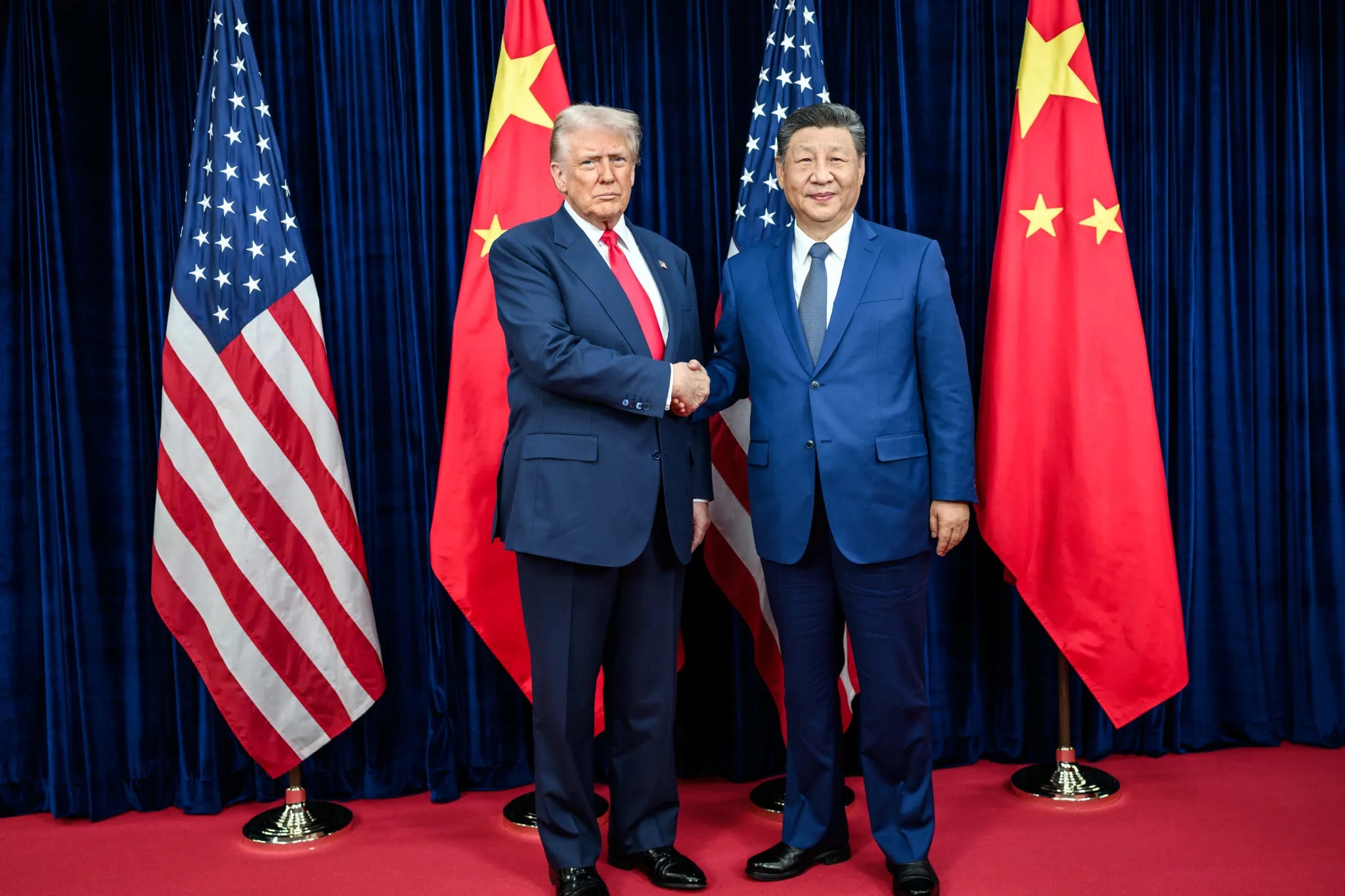
Last week, President Xi Jinping of the People’s Republic of China met with American President Donald J. Trump in Busan, South Korea, at the tail end of the latter’s “grand tour” across the Pacific Rim which included additional stops in Malaysia and Japan. While the meeting was described by Trump as a “12/10,” no radical breakthroughs in Sino-American relations were necessarily achieved. And, while the summit highlighted the relative stability of relations between the two powers, its significance must be interpreted through the superficial and outward-facing lens on which the bulk of publicized foreign policy is based, particularly among the world’s biggest heavyweights like China and America.
As a baseline, Trump and Xi made a handful of vague promises regarding issues as diverse as fentanyl, American agriculture, semiconductors, and minerals. In theory, this wide array of issues will simply be pushed to the wayside by Beijing and Washington for about a year, until a concurrent summit will push them further down the road, whenever that may be… In other news, Trump announced his intention to take an official state visit to China next spring, with Xi following up with his own visit to the United States shortly after.
If you couldn’t tell already, these observations don’t quite align with a meeting which was a “12/10,” as Trump has suggested. So, where does the value behind the summit lie? The answer is far more simple, and shallow, than one may initially surmise.
Looks Over Results…
In respect to China, Trump’s foreign policy platform has initially gravitated towards confrontation, primarily through the medium of economic warfare. Yet, the recent meeting seems to have represented an inflection point in such an approach. There are two possible explanations which I find most convincing, neither of which are necessarily mutually exclusive:
From the very start, the entire purpose of Trump’s tariffs on China has been to reset the existing status-quo with China and to force the two parties to agree to a new framework of relations that better suits the interests of the United States. We’ve seen this with virtually every other country on earth, both friend and foe of America.
We must never forget the third party in all of this: Russia. It seems like Trump is done with playing Putin’s game of subterfuge. While we’ve long heard speculations that Washington sought to pull a “reverse Nixon” on the Chinese by bringing Russia onto their team, it seems like America has come to peace with simply watching from a distance as Russia destroy itself on the fields of Ukraine, alone. Perhaps Washington believes that if it simply distances itself from the madness unfolding in Eastern Europe, it will all work out (and, if done properly, this is not an unreasonable approach). Considering that Russo-American relations are moving in this general direction, making a symbolic gesture of stability within the Sino-American relationship makes America look like it is on good terms with its primary adversary, thus making the Kremlin’s crusade against “Western imperialism” look like an act of madness if the perception of global discord wanes.
While a number of variables are most certainly at play within the Sino-American relationship, the “Russian question” is still as important as ever. America has exploited strengthened ties with China to isolate Russia in the past. While that’s far from what’s happening now, Beijing still has a stake in at least trying to play fair with Washington it if wants to keep its massive economy afloat.
And, while both Trump and Xi have called for the end of the war in Ukraine, what if both were to silently accept its continuation? It’s certainly not a favorable approach to the millions of Ukrainians and Russians being put in harms way in the Donbas, but if the war continues as it has, it may actually play into the interests of both nations. China would be able to further tighten its grip over a weakened and isolated Russia, while the Americans would be allowed to further pursue a non-interventionist approach throughout the world stage as Russia’s sphere of influence recedes not only out of Central Asia, North Africa, and the Middle East, but also away from NATO’s doorstep in Eastern and Central Europe.
Such a modus vivendi most definitely lies far from any stated agreement between both powers as of late, but it all begs the question as to Trump’s newfound approach towards Russia. If he can’t fix it, why try? It certainly won’t help Russia to keep tearing itself apart along its Western border.