

The Worst is Yet to Come for Tehran
The Persian Gulf region braces for the largest American naval deployment to the region since the 12 Day War last summer.

Geopolitical necessities have made America’s naval presence in the Middle East effectively perpetual over the past several decades, whether that be to back the Israelis, invade Iraq, or simply keep the oil trade afloat in the precarious maritime strait that separates the Persian and Arab worlds.
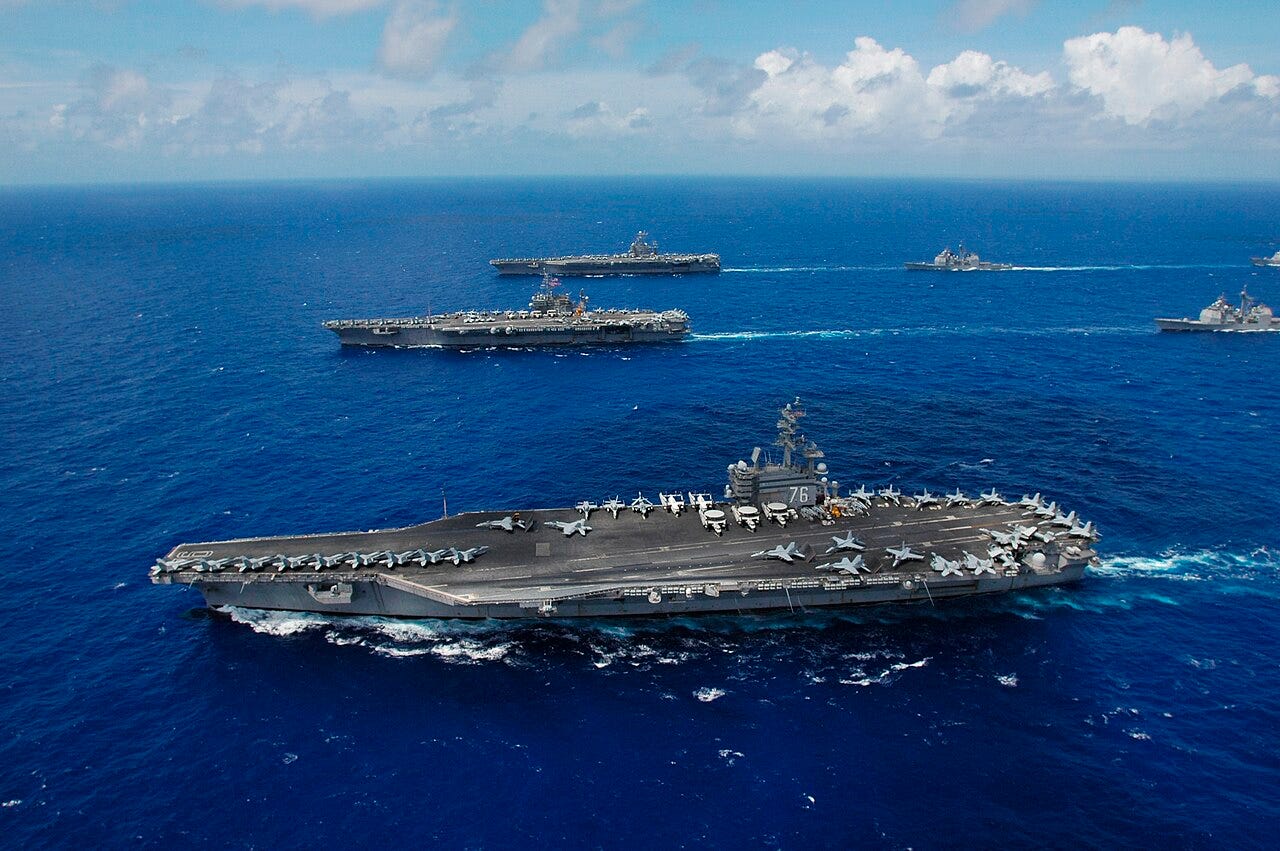
Such a naval presence is obviously crucial to American power projection in the Middle East. During the 12 Day War of 2025, Israel and America’s decisive strikes against the Islamic Republic of Iran, for instance, were largely facilitated by the presence of two American aircraft carrier strike groups in the region.
Tensions in the Middle East were certainly on the upswing during June of 2025, but the following Iran’s defeat, a ceasefire in Gaza, and the steady deterioration of Iran’s regional proxies all added a desperately-needed cessation to hostilities in the region. Citing these improved conditions, America pulled its carriers out of the region and redirected their course for a more pressing matter: blockading Venezuela.
While Washington was busy capturing Maduro, however, its lack of firepower in the Middle East was ill-prepared to respond to the emerging crisis that was Iran’s biggest wave of anti-government protests in the 50 years that the Islamic Republic has ruled the country. Trump claimed that if the Islamic Regime were to fire on civilians, he would respond with force of his own. Questions of outright regime change became very plausible as millions came to the streets demanding the death of the Ayatollah. And yet, the Islamic Republic was able to narrowly escape collapse by shutting down all lines of communication with the outside world and embracing the very violence which the Americans claimed to be a red line.
Yet for Tehran, the game is far from over. While the Americans claimed that they would strike Iran if protests got bloody (which they certainly did, with casualty estimates ranging from 4 to 80 thousand), the cards they had at their disposal were somewhat limited. On one hand, the US lacked a carrier strike group in the Persian gulf to make any American aerial strike truly decisive, while on the other hand US policymakers were presented with no plausible targets to strike within Iran that would tangibly benefit the resolve of ongoing protests. Strikes on Iranian security forces would likely entail civilian casualties as well, a development which could have certainly made the regime’s claim that it was fighting American-backed “terrorists” more convincing.
The Iranian regime may have dodged disaster in the first two weeks of January, but that doesn’t mean its in any better of a situation right now. The regime has solved none of the fundamental economic or political grievances which its population holds, and any effort to do so would require the regime to change its very nature. The Iranian populace may have ceased its unrest in the face of direct military suppression, but it will by no means forget the brutality which the increasingly detested Islamist regime demonstrated against its own people. The next round of unrest, whether prompted domestically or from abroad, will likely be much worse. There is simply no off-ramp remaining for the Ayatollah to stay in power. If anything, its not a matter of if his regime will collapse, but when it will.
Iran’s currency, the Rial, has collapsed so precipitously that it is now equal to $0.00 USD. In Iran’s west, the regime has lost so much control that Kurdish militants have reportedly breached international territorial lines via Iraq, even after the protests have subsided. Dissidents from both at home and abroad have also commandeered Iranian state television system to play anti-regime messages from both the exiled Crown Prince Reza Pahlavi and other anti-regime figures amongst the Iranian diaspora.
And, while America and Israel may have determined that striking the regime a week ago would have been poorly-timed, that doesn’t mean they’ve dropped the prospect for good…
An American “Armada”
Since protests waned in mid-January, the United States has repositioned the U.S.S. Abraham Lincoln Carrier Strike Group from the South China Sea to the Persian Gulf. This gives Washington the firepower it needs to issue the blow against Iran it has threatened to issue. Israel too, while initially wary of American intervention against Iran, appears to be on alert for imminent armed conflict. Most airlines have suspended flights out of Jerusalem and Tel Aviv, while American military bases throughout the Arab Gulf States have been almost entirely evacuated in anticipation of Iranian retaliation if a conflict were to break out.
Perhaps most ominously, some reports have surfaced suggesting that the very American “Delta Force” units which recently orchestrated a kidnapping of a certain Nicholas Maduro in Venezuela have been deployed to Iraq. If true, then that puts those lethal units only 300 miles from Tehran.
Trump claimed that he “wasn’t playing around” when it came to Iran’s killing of its own citizens, and while citing the regime’s “cancellation” of public executions gave Washington a good exit ramp to initially discard its previous claims, the White House may still see American inaction as an empty bluff which needs to be corrected. If the United States wants to avoid such a perception and views striking a weakened Iran as a viable path to instigating organic regime collapse, it is certainly possible that American intervention through air and missile strikes is possible in the coming days or weeks.
Iran is no Venezuela: it may be a shell of its former self, but bringing down a regime with vast sectarian distinctions and a not-easily breached mountainous geography may deter the US from getting itself stuck in a hot mess once more in the Middle East. But if Washington were to strike, it is certainly giving itself the capacity to do so that it lacked just a week or two ago.
And, if you were a President trying to turn the world’s attention away from the Middle East and towards something else to enhance the element of surprise, what better dispute to focus on than Greenland?
Remarkable observation written in late January considering what is unfolding in early March. Looks like you called it.
Well done.