

Too Many Allies?
As Israel and Turkey's mounting rivalry becomes more heated, Azerbaijan's strong ties with both nations will come under unprecedented stress

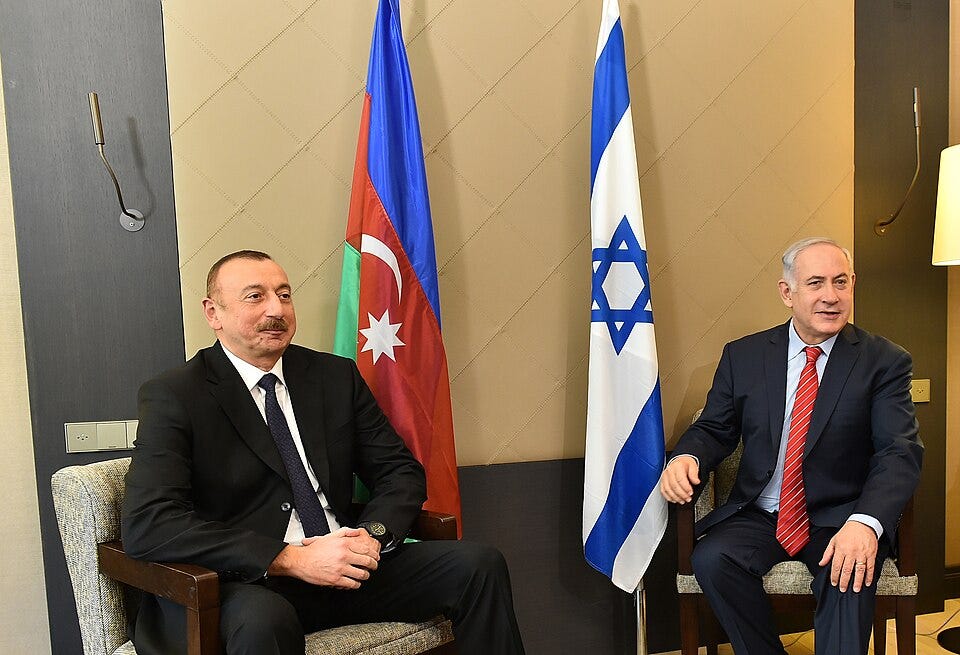
The strong relationship between Israel and Azerbaijan remains one of the few cases in which a Muslim-majority nation has not only recognized the Jewish state, but actively worked towards the construction of extensive bilateral ties with it in areas of defense, energy, trade, and intelligence.
Today, over 40% of Israel’s oil imports come from Azerbaijan, while trade between both nations has jumped by upwards of 50% in the past two years as ties between Israel and other Middle Eastern nations have significantly deteriorated. And, when Azerbaijan launched its rapid offensive against the Armenian-disputed Artsakh region in 2023, its success was partly rooted in the possession of advanced armaments purchased from Israel.
While Azerbaijan has taken on a nominally neutral stance against the War in Iran, it was struck by Tehran in the early days of the conflict. Months after the fact, it was also discovered that Israeli special operatives had used Azerbaijan as a forward-operating base through which to strike northern Iran. Baku may remain “neutral” in the ongoing conflict, but it has most certainly made its regional leanings self-evident.
Beyond Azerbaijan, most of the world’s Muslim nations hold precarious ties with the State of Israel—or no ties at all. What makes Azerbaijan different is a matter of both its past and present. As a former Soviet Republic, Azerbaijan was long under the rule of a government that was generally hostile towards religion. For Azerbaijan and many of Central Asia’s other Muslim states, this has produced a relationship between the state and religion in a Post-Soviet era that is far more secular in nature, making issues inherent to other Muslim nations like that of Palestinian sovereignty far less important in the execution of foreign policy.
More importantly, Azerbaijan and Israel share a common adversary: Iran. While Israel’s grievances with the Islamic Republic of Iran are rather self-evident, Azerbaijan traces its hostilities with Tehran to the presence of millions of Azeri Turks within Iran’s northwestern regions. While the presence of this diaspora within Iran has rarely precipitated revisionist claims from Baku, the general abuse of minority rights throughout Iran has long made Azeri-Iranian ties deeply problematic.
However, Azerbaijan has another, even more important ally: Turkey. United by a similar language, culture, and history, Azerbaijan has seen Turkey as its most important political and economic patron following its independence in 1991. Both nations are aligned through the Organization of Turkic States (OTS), have cooperated on issues surrounding Azeri-Armenian border disputes, hold a mutual defense treaty, and are working towards the adoption of a comprehensive free trade agreement.
The Azeri-Turkish alliance is not only central to both nations’ foreign policies, but also to the propagation of Turkish influence deep into the Caspian Sea Region, a development which has in turn diminished Russian influence throughout its former territories in the South Caucasus. For its part, Azerbaijan has leveraged its strong ties with both Israel and Turkey to become the pre-eminent power of the South Caucasus and one of the region’s most important international actors.
However, Baku’s two most important allies hold one shared flaw: they don’t get along.
While Turkey has long taken a more conciliatory stance towards Israel compared to other Muslim nations, the country has largely abandoned this framework under the leadership of Recep Tayyip Erdogan, who sees Israel as a serious threat to Turkey’s mission of becoming a hegemonic power in the Eastern Mediterranean.
With Iran seriously weakened by the ongoing war with Israel and Saudi Arabia’s regional reputation tarnished by years of implicit compliance to Israel’s strategic demands, Turkey now sees itself as the Middle East’s last Great Power other than Israel. Under Erdogan, Ankara has adopted a foreign policy leaning away from the neutrality of the Kemalist Ideology and moving back towards the regional assertiveness that once defined the Ottoman Empire.
With this new level of Turkish assertiveness has come a newfound expansion of Turkish influence into Syria, Iraq, Egypt, the South Caucasus, and the Gulf States where it was once relatively absent, a development made easier by the stagnation of Saudi, Egyptian, and Iranian influence in the Middle East. However, the militarily ascendant Israelis may very well hold the power to derail these aspirations.
Both Turkey and Israel hold inherently diverging views on how the Middle East should look: the Turks seek to establish a multipolar region under Turkish leadership, while the Israelis believe their sovereignty can be guaranteed through a deeply assertive and indiscriminate stance against each and every potential adversary which may arise in the region. Israel cannot tolerate a future where Turkey is ascendant, nor can Turkey tolerate one where Israel is. In this reality, a bitter rivalry has taken shape—even as the guns have remained fixed on Tehran.
Since 2023, Turkey and Israel have experienced a precipitous collapse in relations. The Turks have strongly opposed Israel’s expansive and assertive array of military campaigns across the region, while some figures in Israel have moved to categorize Ankara as Israel’s next principal adversary once Iran is defeated. In Syria, the installation of a pro-Turkish regime has led to even more friction with Israel, as have the increasingly-divergent Israeli-Turkish views on the political fate of the Kurdish nation in Syria, Iraq, Turkey, and Iran. In fact, when Israel and the United States sought to win over the support of Kurds in western Iran in the earlier stages of the ongoing conflict, some reports suggest that their failure to do so was the product of Turkey intervention.
The Trouble for Baku:
The emerging rivalry between Turkey and Israel is one which deserves far more attention than the scope of this article would allow, yet one of its most important and unavoidable ramifications lies in the country which calls both nations a friend: Azerbaijan.
Over the past two decades, Baku has greatly benefited from the support of both Israel and Iran, yet as the two Middle Eastern powers become more polarized in their confrontation, Azerbaijan will no longer be able remain on good terms with both without being seen as insincere and even “traitorous.” Ultimately, Azerbaijan will have to pick a side in the growing Turkish-Israeli rivalry, and if it cannot, it will be left to find its own path forward—alone.
If Turkey and Israel were to become principal adversaries in the decades to come, an Azeri pivot towards Israel would be seen by the Turks as the betrayal of their closest ally. By the Israelis, it would be met with similar sentiment with the added flavor of an unprecedented energy crisis: not only would Israel lose a rare ally on Iran’s doorstep, but so too would it lose its most important energy supplier.
Baku has tried to avoid making this difficult choice by acting as an intermediary between the two countries, a decision exhibited by Azerbaijan’s hosting of multiple rounds of Israeli-Turkish de-escalatory negotiations on its territory. However, Azerbaijan is no neutral party: it has worked with both countries in shared areas of intelligence and defense far too sensitive to be seen as demonstrative of impartiality. If Azerbaijan’s two allies found themselves on the precipice of war, Baku would not be seen as an intermediary, but rather as a liability to be exploited by the enemy.
The Realities Supersede the Apprehensions:
Luckily for Turkey—and unfortunately for Israel— Azerbaijan has much more to lose from the diminishing of ties with Turkey than it does with the breakdown of relations with Israel. While Israel may represent a key defense patron against Iran and a well-appreciated energy customer for Azerbaijan, Turkey represents the guarantor of everything on which Azeri wealth, prosperity, and sovereignty has been built. Turkey allows Azerbaijan to sell its oil to Western markets through its territory in the first place, while also supporting its growing emergence as an economic powerhouse on the global stage. Israel may sell Azerbaijan arms, but Turkey sells even more, and Ankara’s effective security guarantee on Azeri sovereignty makes Turkey Azerbaijan’s best safeguard against potential threats from Russia and Iran.
Turkey’s support of Azerbaijan is not without reason. The cultivation of an unwavering ally along the Caspian Sea is what enables Turkey to remain politically relevant in regions like Central Asia that it would otherwise be too far away from to shape. It also represents the corridor over which the rapidly-emerging volume of goods being transported from Central Asia to Europe can be transported, a framework that would most certainly supercharge Turkey’s role as an overland trade power.
In summary, Azerbaijan may be forced to make a choice if the Turkish-Israeli rivalry becomes too heated, but that choice will not be difficult. If Israel and Turkey are to engage in a prolonged confrontation across the Middle East, Azerbaijan will side with the country that it needs more, and that country is indisputably Turkey.
While Israel’s confrontation with Iran may have been tolerable to many of the Gulf States, Turkey is not a pariah state like Iran is. The card Ankara holds in a confrontation with Israel that Iran never did is the favor of many of the Middle East’s nation states. For Israel, this could result in the loss of once-critical allies like Azerbaijan and in the realignment of once-complacent neighbors like Jordan, Egypt, and Saudi Arabia.
Azerbaijan has been afforded a regional outlook in which Turkish alignment alone can suffice, but it isn’t the only nation that falls in this boat. For Israel, it is the convenience with which the Middle East’s states could rally behind the Turks that might make Ankara the most formidable adversary Israel has ever faced.
That’s the problem of any multi-vector, omnidirectional or whatever-you-want-to-call-it foreign policy: it might break down when your partners force you to take a stand. Same goes for neutrality to some extent.