

The Polish-Soviet War, Part III
The Attack of the Red Cavalry and the "Miracle on the Vistula"

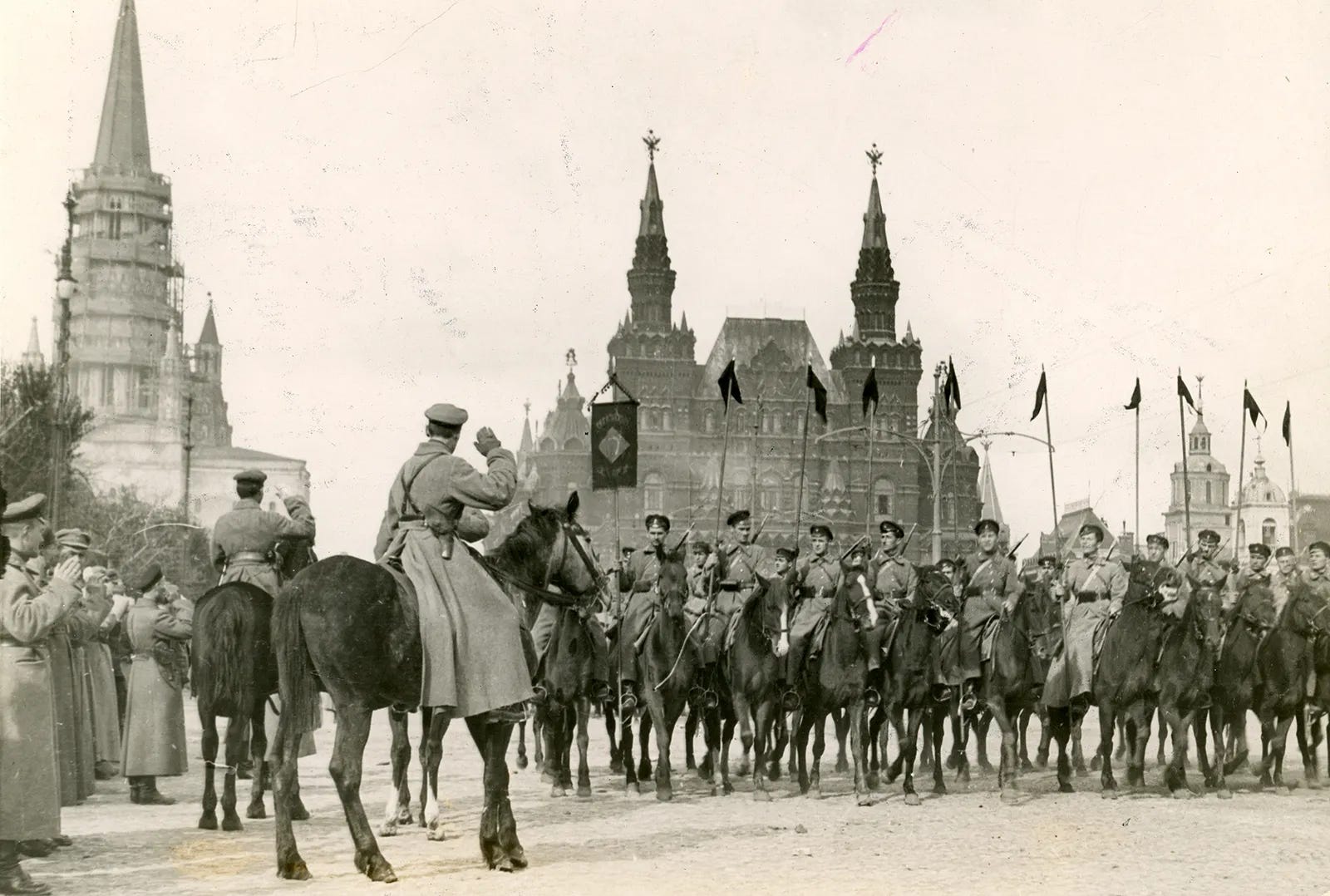
This is the third part in my inaugural Historical Digressions essay series on the Polish-Soviet War of 1919-1921. To read the previous (second) part, click HERE, or if you’re just getting started and want to read the first part, click HERE. Thanks for giving my work a read, and I hope you enjoy this piece on one of the most important yet forgotten conflicts in European history.
Poland’s victories in Ukraine, Belarus, and Lithuania throughout 1919 and early 1920 were nothing short of exceptional. The formidable Red Army had been rattled to its core, with the Politburo now viewing the Polish invasion as the greatest threat to Russian territorial integrity in the west since the Brest-Litovsk treaty had been signed in 1918. For Józef Pilsudski’s federalist aspirations, the captures of Minsk, Wilno, and then the great Ukrainian capital of Kyiv in 1920 represented major steps towards Poland’s efforts to build a “federation in the borderlands” that would prove strong enough to deter further Soviet aggression through the collective unity of Eastern Europe’s non-Russian peoples.
However, the spring of 1920 brought sentiments that were neither clear-cut nor jubilant for the Poles. The Soviet war machine had finally been pressed into action against the threat on the western front, while Polish troops had failed to deal a decisive blow to Soviet troops during their retreat across the Dnieper River. Now entrenched on the Dnieper’s Right Bank, the Poles held neither the resources to continue their advance into the unprotected flatlands of Eastern Ukraine nor the manpower to resist what would surely be a formidable Soviet counterattack against Kyiv in the spring of 1920…
The Soviet Counterattack and the Arrival of the “Red Cavalry,” April 1920:
The capture of a city as large and strategically critical as Kyiv proved to be nothing short of a red line for Moscow, whose egalitarian views on nationalism failed to conceal a spirit of Russian imperialism that ironically held sway among many Bolsheviks. With the threats posed by the White Generals Kolchak and Denikin largely countered by the time of Kyiv’s capture, Soviet Russia now poised itself to point the full thrust of the Red Army towards Poland, which had thus far only bought time for the onslaught that was to come.
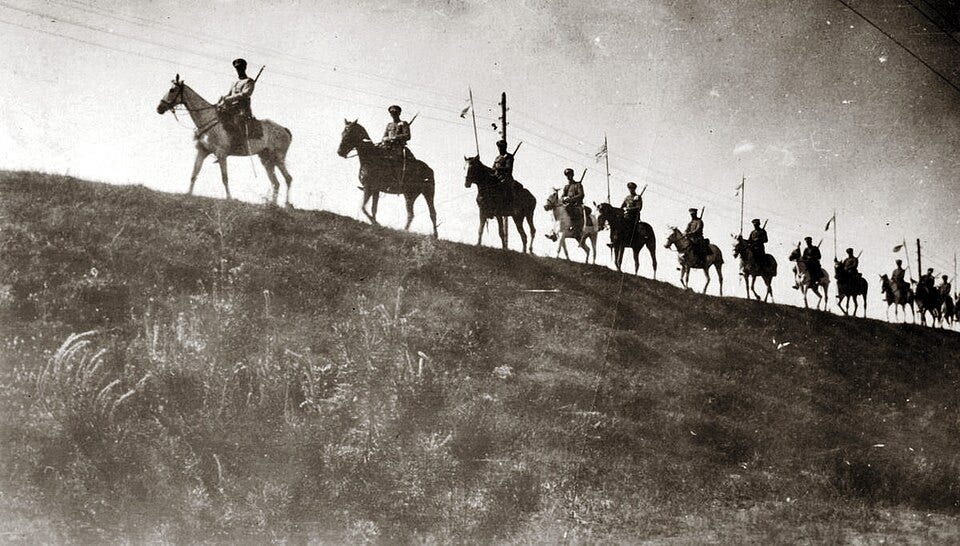
At the vanguard of this grand Soviet counterattack would be the Konarmiya, or the First Red Cavalry Army. The Konarmiya, under the leadership of Semyon Budyonny, represented the most lethal and terrifying fighting force on the entire European continent at the time. Composed of former Cossacks, revolutionaries, and fugitives alike, the track record of victories held by the Red Cavalry against the Whites led many in Warsaw to equate them to “the reincarnation of the hordes of Genghis Khan.” Among the Red Cavalry would include future Soviet hero of the Great Patriotic War Georgy Zhukov and the famed writer and war correspondent Isaac Babel, yet the dignified positions reached by these two men were extreme outliers in a pool of cavalrymen notorious for their marked and unwavering brutality.1
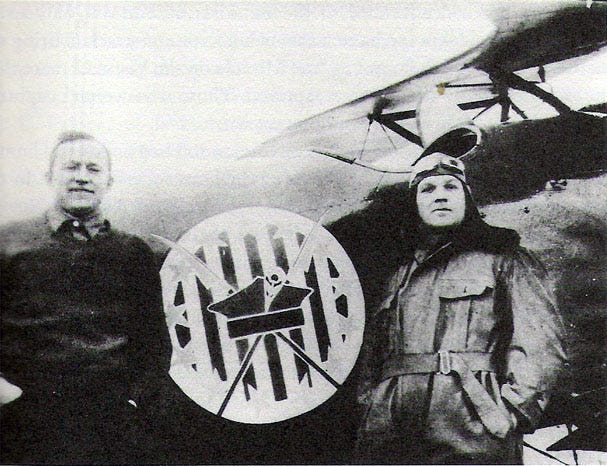
It was primarily Western assistance that helped Poland foresee the Russian counterattack on Polish positions along the Dnieper River near Kyiv. The Kosciuszko Squadron, an air squadron of American pilots who volunteered to assist the Polish state in the same spirit as had Polish General Tadeusz Kosciuszko during the American struggle for independence, was able to use its critical advantage of air reconnaissance to spot the Konarmiya as it advanced from the Don Steppe of southern Russia to the frontlines of Central Ukraine.
On May 25th, an American pilot flying over Ukraine mistook the advancing Konarmiya for a “sand storm” that was “masked in the clouds of dust raised by thousands of hooves.”2 Upon arriving at Kyiv, the long awaited attack of the Konarmiya proved as deadly as the Poles had feared. The Konarmiya issued a crippling blow to Petliura’s new Ukrainian government and prompted the Polish divisions that could escape the blitzkrieg of armed cavalry into a chaotic and disorganized retreat back into the Polish heartland. This phase of the war would see Poland’s near-complete military collapse at the hands of a ruthless Soviet offensive, making this campaign particularly notable for its characteristics of violence and human suffering among soldiers and civilians alike.3
Isaac Babel’s famed work Red Cavalry, or Konarmiya, has long been regarded as a classic work in the realist school of literature for its vivid descriptions of the violence Babel observed firsthand while serving as a journalist in the Konarmiya.
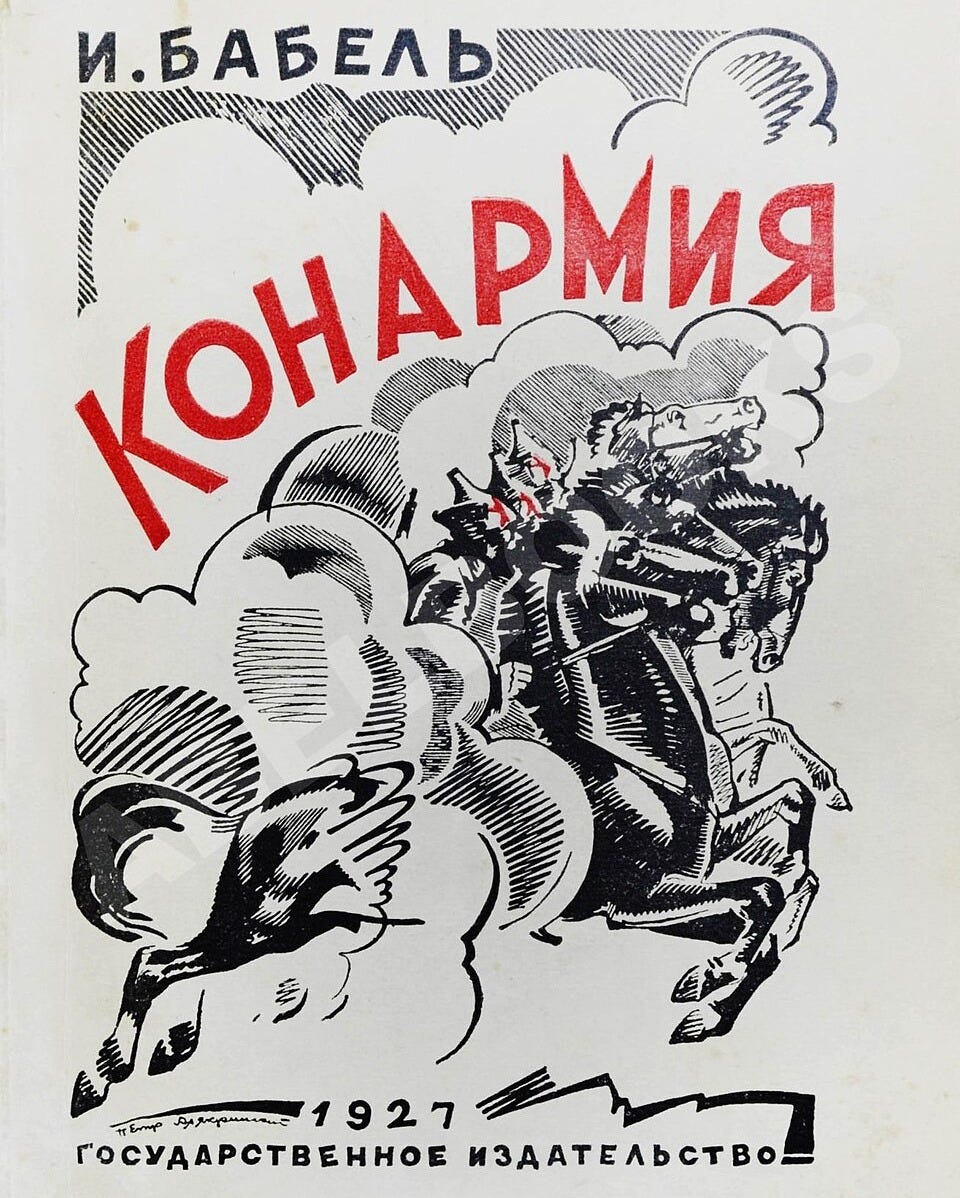
Babel’s accounts on the Polish-Soviet War also provide valuable insight into the inherent qualities that made the Konarmiya such a lethal force against its Polish adversaries. According to Babel, the tactical strength of the Konarmiya resided in its “triangle on which our ways are founded: sword - tachanka - horse…”4 The main components of the Konarmiya were thus its sabre-cavalry and, most importantly to Babel, its use of the Tachanka, a horse-drawn cart from which was mounted a large machine gun.
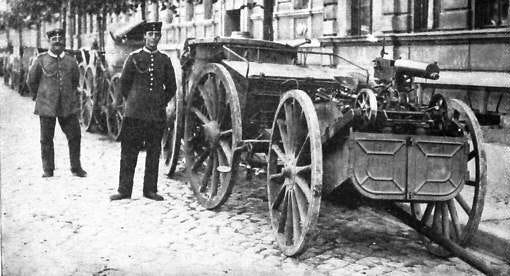
These new weapons revolutionized warfare on the plains of Eastern Europe, bringing both “unprecedented maneuverability” and the basis for a “formidable means of mobile battle” that greatly eclipsed the potency of standard infantry, artillery, or cavalry alone. On the flat terrain of Ukraine, Russia, and Poland, such a weapon of war provided the perfect mixture of heavy firepower and reliable mobility to the Konarmiya. The tachanka’s effect on the Red Army’s success would thus be comparable to that of the tank or warplane in the Second World War, a cunning edge held by Budyonny’s men that would allow them to spread deep into the Polish interior.
The Defense of Poland and the Battle of Warsaw ( July-August 1920):
By the late summer of 1920, the Red Army’s offensive had driven Polish forces entirely out of the Borderlands. Following the captures of Kyiv, Minsk , and Wilno to the Red Army, Soviet forces continued their advance west of the Curzon Line, taking the eastern city of Białystok and threatening Lwów and Kraków to the south. Piłsudski and the Polish high command diverted all national resources towards the defense of Warsaw, which was further endangered after its railway with the port of Gdańsk was severed by advancing Soviet forces. From these captured territories around Białystok emerged a Soviet-aligned Provisional Polish Revolutionary Committee.
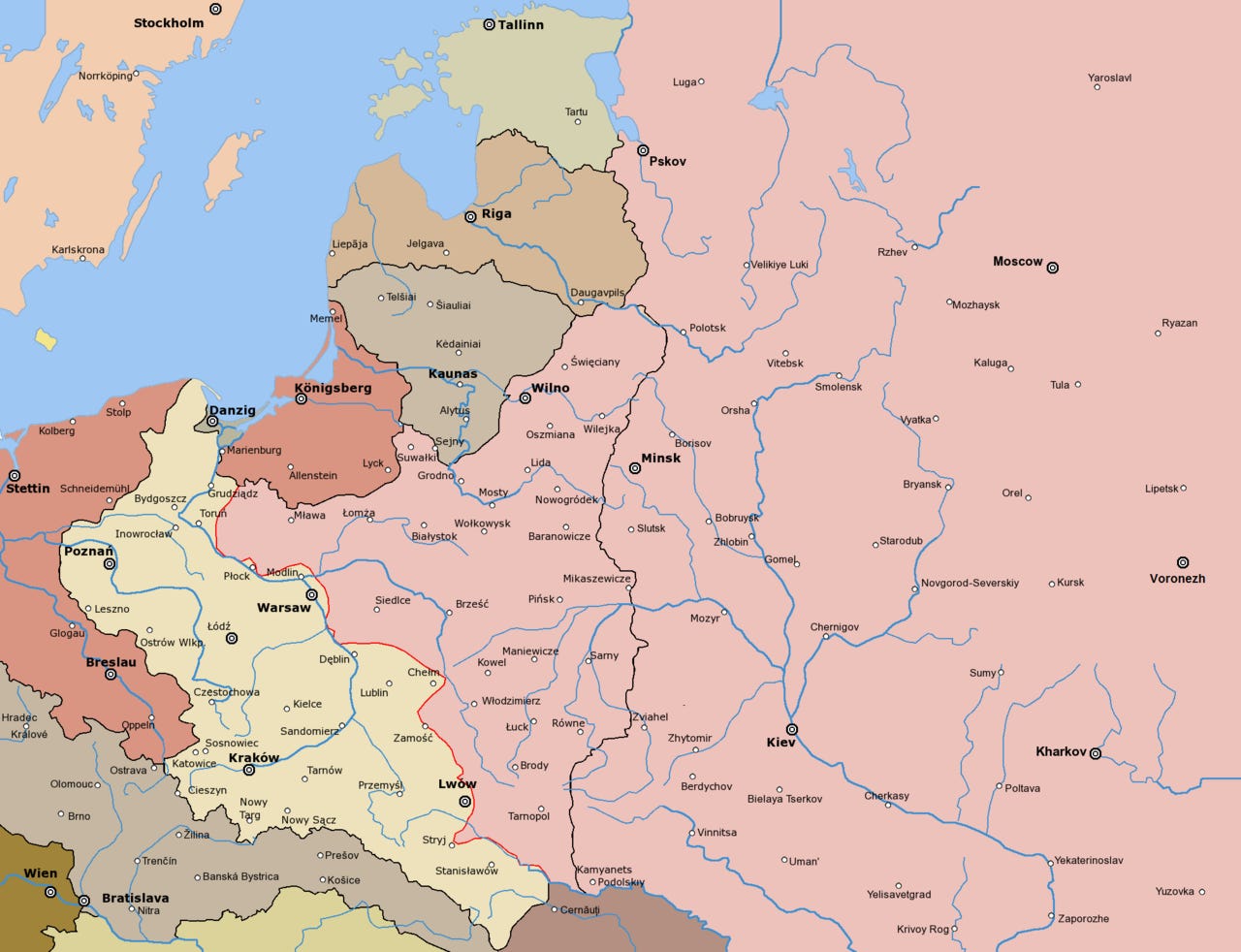
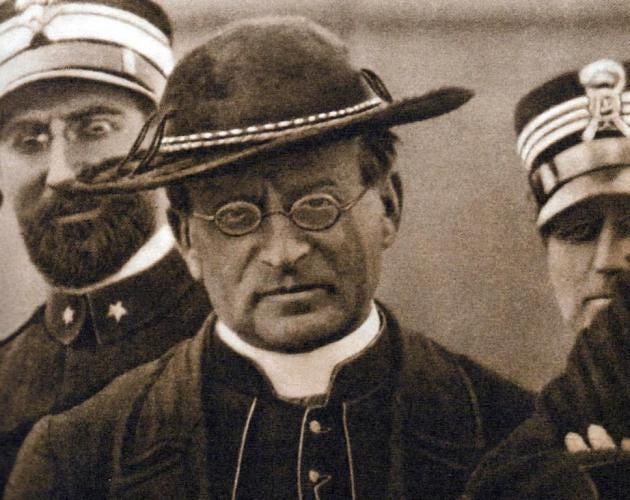
Under Julian Marchlewski and Felix Dzierzynski, this provisional Soviet government sought to replace Piłsudski’s government in Warsaw with a communist one upon its imminent capture.5 With reports of Soviet forces approaching Warsaw’s suburbs, all hope for Piłsudski’s Polish state seemed dead. While the Polish army showed no signs of giving up their defense, the overwhelming sentiment both at home and abroad held that Poland’s capitulation to the Red Army was inevitable. Piłsudski’s government considered evacuating westwards towards Poznań, as had almost every foreign embassy and diplomatic mission in Warsaw. There were, however, a few fascinating exceptions to the mass evacuation from Warsaw that took place in July and August of 1920. The only ambassador to stay in Warsaw was Apostolic Nuncio Achille Ratti of the Holy See. In the wake of impending Soviet conquest, Ratti believed it his personal duty “to brave the hordes of Antichrist in person.”6 Such was equated the anti-religious barbarity of the hordes of Red Army to the devoutly Catholic and patriotic Polish people. Ratti’s decision to stay behind and confront such barbarity firsthand would undoubtedly be a key reason for his future election to the seat of Bishop of Rome as Pope Pius XI.
In its moment of desperation, Poland was also presented with some notable support from its Western allies—even if said support was more symbolic than substantive. While much of this support from France and Great Britain was insignificant at best, it painted a superficial image of intense allied involvement within Polish affairs that was further supported by a harsh–yet somewhat empty-worded– condemnations Russia’s victories over Poland. Amidst ongoing Soviet advances in July, Lloyd George and his foreign minister Curzon had issued strong threats against the Soviets in messages such as the “Curzon Line Telegram,” which reiterated the Entente’s guarantee of Polish independence and even at times threatened military intervention in Poland if the Soviets did not halt their advances.
Lloyd George’s diplomatic offensive against Russia was further developed through the creation of the Interallied Mission to Poland headed by French General Weygand and French Ambassador to the United States Jean Jules Jusserand.7 This mission sought to de-escalate the Russo-Polish situation so as to end a war which they believed Poland could not possibly win on its own. As such, the Interallied Mission served in an exclusively advisory role to the Poles, not having any significant effects on the ongoing combat outside of Warsaw. Regardless of its intentions, the mission’s late arrival to Warsaw in late July could not have possibly altered the fate of Poland that was actively being decided at the gates of Warsaw.
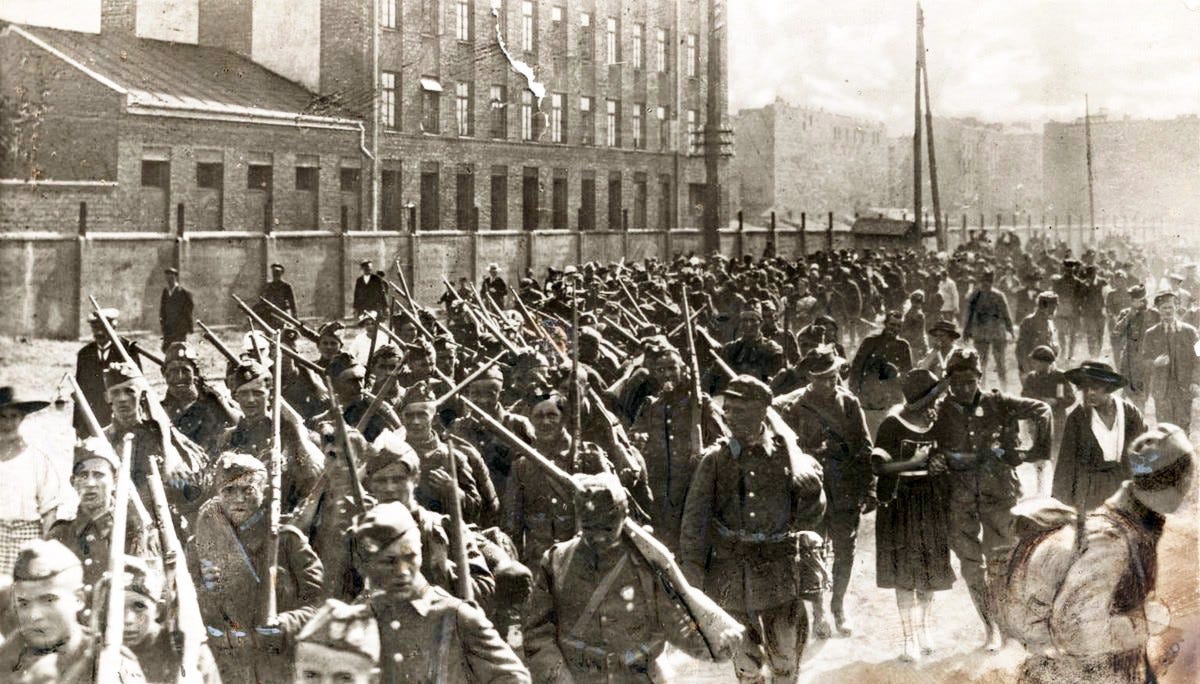
However, in their shared moment of desperation, the Poles responded to their plight with exceptional preparation and composure. Under the military genius of General Kazimierz Sosnkowski, the Polish high command planned for a campaign around Warsaw that would significantly contrast with the open-field tachanka and cavalry campaigns seen on the flat borderlands. In the words of Sosnkowski, the impending battle of Warsaw would mirror a “regular war of massed forces, where we encounter all the firepower and mechanized aids of the recent World War” and “a national war, where we face not merely the Bolshevik guards but the concentrated might of all Russia.”8 Trotsky in fact had declared the offensive into Poland as “the foremost problem of all Russia” upon crossing the Curzon Line, showing that the impending Battle of Warsaw would be unlike any battle seen in the Polish War, or even Russian Civil War, thus far.9
When the long-awaited Battle of Warsaw commenced, the Red Cavalry actually moved south in the direction of Lwów and Kraków with support from General Alexander Yegorov’s forces. In large part, this incongruous pivot southwards can be attributed to the hubris of Josef Stalin, a field commander in Southern Poland who believed that the capture of the major southern city of Lwów would be of greater strategic importance than the conquest of Warsaw, thus drawing forces farther north into a southward trajectory. It’s important to note that this brazen act of defiance to Tukhachevsky’s strategic imperative was influenced not only by differing strategic opinions, but by rapidly-emerging factional rivalries within the Bolshevik apparatus between Stalin and the other generals on the Polish front. Unsurprisingly, when Stalin ultimately took power in Moscow, Tukhachevsky would be one of the first to fall victim to his purges.
Under the command of Mikhail Tukhachevsky was the army group which directly struck Warsaw from the east bank of the Vistula River.10 However, the large gap created by two rapidly diverging Soviet army groups presented the Poles with an incredible opportunity to outflank the advancing Soviet forces. Piłsudski, now recognizing that Poland’s army could not possibly resist a direct Soviet attack on Warsaw, ordered his strongest divisions to launch a risky attack between the gaps in Tukhachevsky and Yegorov’s armies.
What followed was an utterly extraordinary breakthrough by Polish troops, who struck the Soviets in such a vulnerable position that they were forced to stage a chaotic retreat and to abandon all hopes of capturing Warsaw. In what came to be called the Miracle on the Vistula, Poland had seemingly been saved from imminent collapse by Piłsudski’s astute leadership and, according to many, divine intervention on the side of the Polish people.
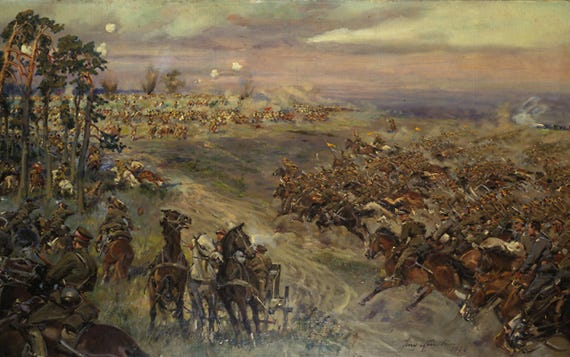
In Northeastern Poland, many of Tukhachevsky’s men were surrounded along the German-Polish border in East Prussia, while the few who escaped were routed out of Poland, much of Belarus, and Lithuania in a lethal Polish counterattack that was cemented at the Battle of the Niemen River—the second largest battle of the war and yet another unprecedented Polish victory following the triumph at Warsaw. Along the Polish-Ukrainian border near Zamosc, the Poles also shattered what was left of the once-formidable Red Cavalry at the Battle of Komarow, an engagement which laid host to the largest and last modern cavalry battle between Europe’s two most storied mounted forces.
The Polish-Soviet engagement at Komarow would come to be profoundly symbolic in its own right: whether in peace or in war, the Winged Hussars of Poland and the Cossack Hosts of the East had lived and struggled alongside one another across the Eastern Borderlands for over a millennia, and now in the year 1920, the two timeless adversaries clashed for one final time on the storied plains of Galicia. Twenty years from that moment, the rivalry would come to be supplanted by an industrialized means of war that did not perpetuate the tradition and identity of Europe’s mounted Steppe peoples, but one which irreversibly destroyed it.
Upon the verge of capitulation, the Poles had been able to turn a last stand into a complete and utter rout all the way across the Borderlands in spite of all odds. Poland had proven that a state could not only exist along Russia’s periphery, but triumph against its larger neighbor on the battlefield. As abstract as this precedent may have been, it would inspire the occupied peoples of Europe’s east all the way into the present day when Ukrainian sovereignty finds itself in a similar position.
The Soviet retreat which followed the campaign at Warsaw may have marked the de-facto end of the Polish-Soviet War, but as the final essay in this series will show, the war for Pilsudski’s vision of a strong Poland was still being waged with full intensity.
In the next part in this essay series, I will discuss the Treaty of Riga, the implications of the Polish-Soviet War for the Interwar Period, and offer a summative commentary on the conflict’s decisive precedents for+ modern Polish foreign policy in Eastern and Central Europe.
Norman Davies, White Eagle, Red Star: The Polish-Soviet War 1919-1920 and the ‘Miracle on the Vistula’ (London: Pimlico, 2003), 115-117.
Ibid, 120.
Ibid, 126.
Isaac Babel. Red Cavalry and Other Stories. Penguin Classics. London: Penguin Group, 2005, 129.
Davies, Eagle, 153.
Ibid, 189.
Ibid, 173.
Ibid, 190-191.
Ibid, 138.
Norman Davies. “The Soviet Command and the Battle of Warsaw.” (Soviet Studies 23, no. 4, 1972), 6.