

Print Editions
The Perch releases signature print editions three times a year. These publications, often between 25 and 30 pages, feature a collection of essays pertaining to one thematic geopolitical development happening in Eurasia. Great thought and research is put into the subject matter of each print edition, since we believe these publications should prove timeless and resistant to the everyday fluctuations in an increasingly volatile world.
Copies of The Perch in print are the perfect publication for institutional subscribers, our most dedicated readers, and anyone who appreciates learning about current events with an added flair of intellectualism. Print editions are only released three times a year in one-time, limited-number print runs, with most copies usually being sold during the pre-order cycle. To receive the latest updates on pre-orders, release dates, and previews of what to expect in each print edition, consider subscribing to The Perch for free.
Currently, The Perch Volume 1 Number 2: After Iran is in stock and available for purchase. Reach out to me at wbpace14@gmail.com or message The Perch directly on Substack to reserve your copy!
Past Editions:
Volume 1, Number 1: Trouble in Borderlands: The War in Ukraine and the Unravelling of the Eurasian Periphery
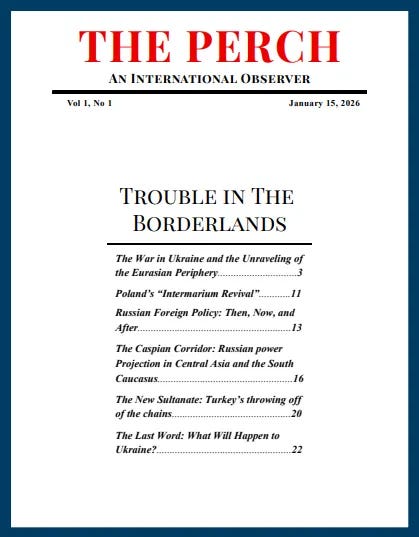
This inaugural edition of The Perch explores the strategic overextension which has defined Russia’s War on Ukraine, a conflict which has forced Moscow to surrender much of the geopolitical influence it once held throughout its “Near Abroad” in Eastern Europe, Central Asia, the South Caucasus, and the Far East. Such a strategic recession has allowed for formerly marginalized neighbors of Russia to detach from the Kremlin’s sphere, and for near-peer rivals like Poland, Turkey, Japan, and China to better consolidate their positions throughout the Post-Soviet Sphere.
Volume 1, Number 2: After Iran: The Unmaking of the Modern Middle East:
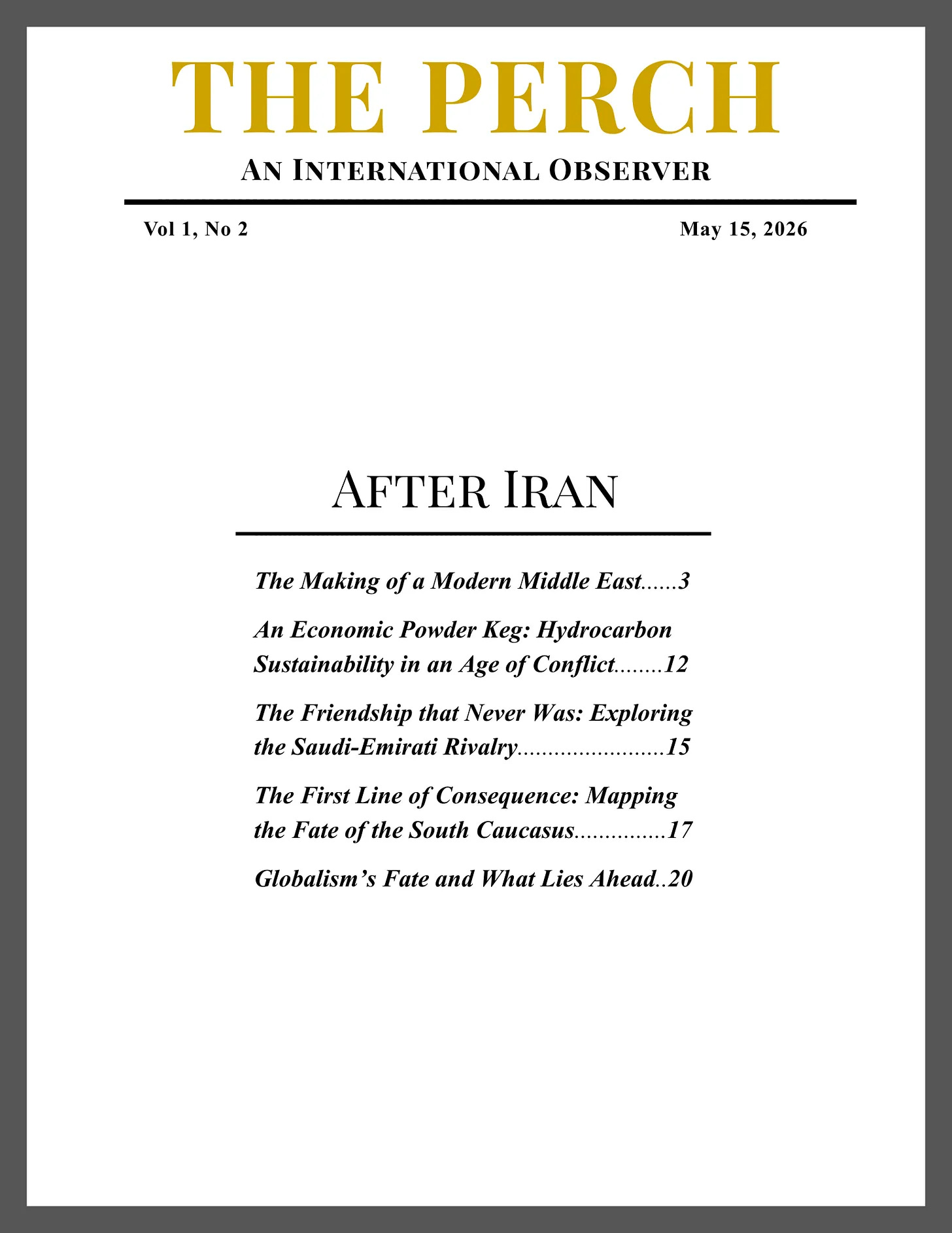
This print edition— published amidst the Third Gulf War of early 2026 between Iran, Israel, and the United States— operates under the premise that the “Middle East” is just as much a historical cycle of transnational geopolitical systems as it is a physically distinctive region of the human geography. Whether it be the Romans or the Ottomans, Alexander the Great or Lawrence of Arabia, or the Crusaders and the Mongols, the Middle East has been organized around distinctive systems of governance by external powers to control the region’s critical resources and geography for thousands of years. The most recent iteration of this system is America’s “Modern Middle East,” a political and economic framework designed to extract the region’s critical hydrocarbon resources, to keep global waterways safe, and to prevent the Islamic Republic of Iran from ever upsetting this status-quo.
As this edition argues, the American and Israeli offensive against Iran has shattered the foundations of the “American System” by ending Iran’s effective containment, empowering the country to bring ruin to the region’s waterways, and thereby destroying the safeguards in place to guarantee the safe export of hydrocarbons from the Gulf States to the World. What follows next is beyond the scope of our current understanding, but it will most certainly involve the conception of a new, inherently different system of transnational governance in the Middle East—or an interregnum of cataclysmic proportions.
Volume 1, Number 3: coming September 2026:
Return to this page in August for live updates.